
Amazon Prime Days 2026: A Complete Guide for U.S. Sellers
Descriptions
By this time, you might already know that Amazon has officially confirmed that Amazon Prime Days 2026 will move to June, the first time it’s happened this early since the pandemic-era shift.
The Amazon Prime Day 2026 dates have been officially confirmed. Amazon hasconfirmed that the Amazon Prime Days 2026 starts from June 23 to June 26
If you were mentally preparing for “Prime Day in July,” your runway just got four weeks shorter.
So now, the deals you could set up in June last year needed to be set up in April this year. The inventory that arrived in late June last year needed to be inside Amazon’s fulfillment centers by May 27. Sellers who haven’t adjusted their timelines are already behind.
This guide covers what’s actually different in Amazon Prime Days 2026, the real deadlines, a strategy that protects your margins, and what to do the moment Prime Day ends.
Quick Gudie:
- What Amazon Prime Days 2026 Actually Does for Sellers
- The Amazon Prime Days 2026 Deadlines You Cannot Miss
- The impact of tariffs on sellers during Amazon Prime Days 2026
- The New Pricing Rules That Will Reject Your Amazon prime day 2026 deals
- Your Inventory Can Kill a good Amazon Prime Day sale
- The Rufus Factor (Now Alexa Shopping): AI Search Can boost conversions for your 2026 Amazon Prime Day
- Prepare for Amazon Prime Days 2026 with a better PPC strategy
- Amazon Prime Days 2026 Deals: Which Deal Types Actually Work in 2026
- The Product Categories That Actually Drive Volume during Amazon Prime Days 2026
- What to Do During the Prime Day Event
- What to Do After Amazon Prime Days 2026 Ends (Super Important Stuff)
- Final thoughts on Amazon Prime Days 2026
What Amazon Prime Days 2026 Actually Does for Sellers
Amazon Prime Day 2025 drove $24.1 billion in U.S. online spending across all retailers over its four days, the equivalent of two Black Fridays compressed into a single week. That was a 30.3% jump over 2024.
Amazon called it the biggest Prime Day in its 11-year history. Independent sellers, mostly small and medium-sized businesses, hit record sales and unit sales. Day 1 accounted for 36% of the total event volume. Sales spiked again on Day 4 as deal urgency peaked.
The four-day format, introduced for the first time in 2025, fundamentally changed the event dynamic. Shoppers spent Day 1 researching and comparing prices across Amazon, Walmart, Target and Best Buy (57% of Prime Day shoppers compared Amazon’s prices to other retailers before buying). By Day 4, the urgency of a closing event pushed conversions hard, and sales jumped over 400% on the final day compared to the middle of the event.
For 2026, Amazon is promising more of the same. But it’s arriving four weeks earlier, with tighter rules and a different cost environment. The sellers who do well will be the ones who planned around those realities before June arrived.
Update: Amazon has officially confirmed that the Amazon Prime Days 2026 starts from June 23 to June 26
The Amazon Prime Days 2026 Deadlines You Cannot Miss
Amazon doesn’t give you much cushion when you miss these. The inventory deadline isn’t a suggestion, if your stock isn’t checked in by the cutoff, there’s no guarantee it gets processed in time for the event.
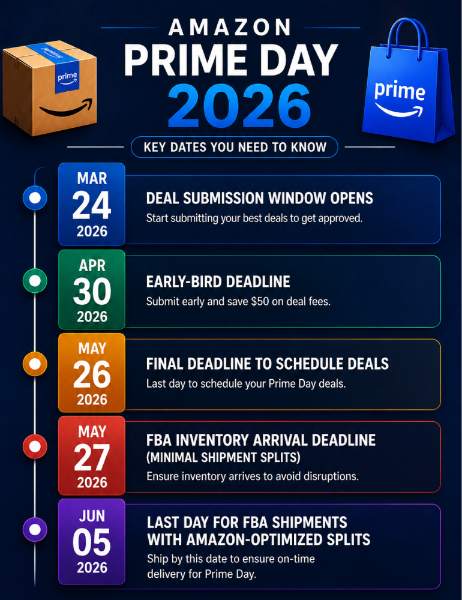
March 24, 2026: Deal submission window opens
April 30, 2026: Early-bird deadline: Amazon lightning deals and Best Deals submitted by this date get $50 off the standard $100 upfront fee. If you have multiple deals running, that adds up fast. (Also already passed, file this away for 2027.)
May 26, 2026: Is the final deadline to schedule Best Deals, Lightning Deals, and Prime Exclusive Discounts. After this date, you’re locked out of deal-based promotional placement for the event.
May 27, 2026: FBA inventory must arrive at Amazon fulfillment centers (minimal shipment splits). This is the hard cutoff for standard FBA. Amazon may accept inventory after this date, but there’s no guarantee it will be processed in time. If it’s not checked in, your listings won’t have Prime-eligible stock when the event opens.
June 5, 2026: Last day for FBA shipments with Amazon-optimized splits. If you’re using AWD as a buffer, this is your secondary cutoff.
The shift to June is literally squeezing every seller. One seller in the Amazon forums put it plainly: “I didn’t even realize deals closed in May until I went to submit in early June. Completely locked out of Lightning Deals.”
The impact of tariffs on sellers during Amazon Prime Days 2026
Here’s the thing that separates Amazon Prime Days 2026 from every previous Prime Days. The calculation that you have made in your mind on your deals will impact them differently this year.
With cumulative tariffs on Chinese imports potentially exceeding 200% in certain product categories, a deal that made financial sense at a 30% discount last year might only be viable at 12% now. Sellers are running Prime Day economics on products that cost significantly more to land than they did 18 months ago.
What experienced sellers are actually doing:
- Running fewer SKUs as promoted deals, focusing only on products where the margin can absorb both the discount and the elevated CPC costs during Prime Day
- Holding pre-tariff inventory specifically for Prime Day to protect margin at fuller prices
- Applying blanket discount rates is over, the brands that are winning are doing per-ASIN profitability math before they submit anything
Before submitting any deal, make sure you follow this formula:
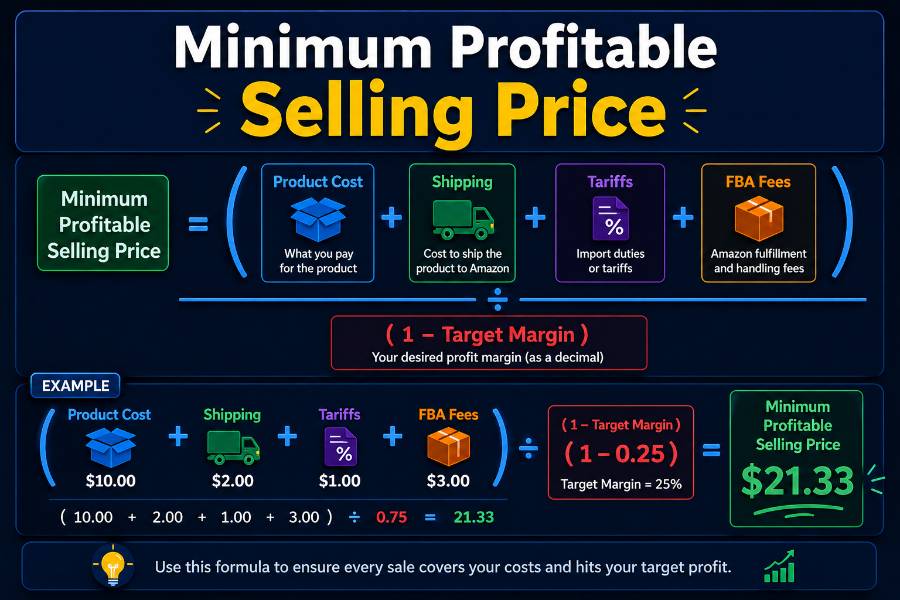
Never set your deal price below this number, even if it means a smaller “badge” or lower visibility.
Selling at a loss for volume without a clear customer lifetime value strategy isn’t a Prime Day strategy; it’s just burning money during your busiest week.
Good news for sellers is that Amazon has relaxed Buy Box suppression rules for tariff-driven price increases, acknowledging that these are market-wide cost shifts rather than individual seller price gouging. That’s a meaningful change if you’ve had to raise prices in the last year.
The New Pricing Rules That Will Reject Your Amazon prime day 2026 deals
Amazon tightened deal eligibility for 2026 in a way that catches a lot of sellers off guard. There are now two hard pricing rules your deal must pass:
The 60-Day Rule: Your deal price must be equal to or lower than the lowest price you’ve sold that ASIN for in the past 60 days, including previous coupons, Lightning Deals, and any other discounts.
The 30-Day Rule: Your deal must be at least 5% lower than the lowest price from the past 30 days.
Here’s our honest take on this for sellers:
You sell a kitchen gadget normally at $49.99. In April, you ran a 15% coupon to boost conversion, and it dropped to $42.49. That April coupon is now your 60-day floor. Your Amazon Prime Days deal price must match or beat $42.49. You can’t come in at $44.99 and expect approval.
But instead of that, if you also ran a 10% PED (Prime Exclusive Discount) in May at $44.99, your 30-day low is $44.99. Your deal must now be 5% below $44.99, which means at or below $42.74. But your 60-day floor from April is still $42.49, so the effective price floor is $42.49.
This results in a seller who thought they were building “momentum” with pre-Prime Day discounts having actually boxed themselves into a deal price that barely leaves any margin left once you factor in the $100 upfront fee plus 1.5% of promotional sales.
Amazon is now displaying full price history to shoppers going back up to 12 months. That strikethrough price showing “$49.99” next to your “$42.49 deal”? Amazon’s system validates it against your actual sales history.
If your product hasn’t sold at $49.99 in a meaningful way recently, the strikethrough doesn’t render. Your deal looks less compelling than your competitor’s, even if the absolute price is the same.
A practical checklist for sellers before the 60-day Amazon Prime Days 2026 period:
If you need conversion support before the Amazon Prime Days 2026 event, and most sellers do move away from public price cuts entirely. Instead:
- Raise PPC bids on your highest-converting keywords to buy more visibility without touching price history
- Run search term expansion in auto campaigns to surface new converting terms
- Improve your Amazon product listing quality (images, A+ content, video), which improves CVR without discounting
- Use Amazon Posts for brand visibility with zero impact on pricing records
The sellers who protected their pricing history for 60–90 days before Prime Day have the most flexibility to run compelling deals on event day. The ones who kept running coupons through May are working with a ceiling that’s already too low to make the deal math work.
One more thing that trips up multichannel brands: Amazon actively monitors pricing across major retailers.
If Target or Walmart shows your product cheaper during their competing summer sales, Amazon’s A9 algorithm can match that price or suppress your buy box, which then sets a new floor for your deal eligibility.
If you’re planning promotions on other channels in the 60 days before Prime Day, model out the Amazon pricing implications first.
Your Inventory Can Kill a good Amazon Prime Day sale
Every seller on r/FulfillmentByAmazon has a story about running out of stock during an event. During Amazon Prime Day, a stockout indicates your search ranking drops at the exact moment when traffic momentum could have carried you for weeks afterward.
How to calculate what you actually need:
Start with your average daily sales for the 30 days before the event, then apply a category multiplier based on past Prime Day lifts. A conservative formula:
(Normal daily sales × Category velocity multiplier × 4 days) + 25–50% buffer
For most sellers, the category multiplier sits between 3x and 6x normal daily velocity. Electronics and home products historically hit 4x–6x. Pet supplies and consumables run closer to 3x–4x.
Add 25% to whatever number you land on. If you sell out on Day 2, you’re watching the rest of the event from the sidelines with an empty Buy Box.
The hybrid fulfillment strategy most experienced sellers use:
Keep your primary inventory in FBA. Hold overflow at a U.S.-based 3PL that can process FBM (Fulfilled by Merchant) or Seller-Fulfilled Prime orders when your FBA stock runs low. This protects you against both demand spikes and FBA restock limit surprises, which tend to appear in May and June without warning.
One important change if you’re using Amazon Multi-Channel Fulfillment (MCF) for Shopify: all orders now pull from the same FBA inventory pool. If you’re fulfilling external orders from FBA during Prime Day, you need to account for that demand when you’re forecasting. Sellers who forget this have run into stockouts on Amazon while fulfilling Shopify orders from the same bins.
The Rufus Factor (Now Alexa Shopping): AI Search Can boost conversions for your 2026 Amazon Prime Day
Amazon’s AI shopping assistant, Amazon Rufus AI which is now Amazon Alexa Shopping now influences an estimated 25–35% of Amazon searches, and monthly usage grew 140% year over year. As of Q3 2025, 250 million shoppers had used it, and customers who interact with Rufus are 60% more likely to complete a purchase.
During Prime Day 2025, GenAI traffic to U.S. retail sites increased by 3,300% year over year. That’s not a rounding error, shoppers are increasingly using conversational AI to find products, and that behavior accelerates during high-intent shopping events.
What this means for your listings:
Traditional keyword optimization gets you into search results. Rufus optimization gets you into AI-generated recommendations. Those are two different things.
Rufus answers use-case questions. “What’s a good vacuum for pet hair on hardwood?” or “Which supplements actually help with sleep?” These are Rufus queries that bypass traditional keyword search entirely. If your listing doesn’t have content that answers these types of questions, you’re invisible to that traffic.
What to actually change:
- Your bullet points should answer the top 3–5 questions a buyer would ask Rufus before buying your product
- Use customer review language in your listing copy. Rufus pulls from reviews to validate claims
- A+ content should be structured around comparison scenarios, not just feature lists
- Video content is now an advertising input as well as a conversion tool. Rufus surfaces it
Sellers with listings optimized for Rufus are reporting meaningful BSR improvements and TACoS declines because Rufus-driven discovery requires no ad spend.
Prepare for Amazon Prime Days 2026 with a better PPC strategy
Of course, the easiest starting point is to start with the cost reality. CPCs spike 60–80% during Amazon Prime Days 2026 on top of a base that’s already rising. Average CPC for top keywords during Amazon Prime Days 2026 is expected to reach $2.50 to $8.00, up 15–25%.
In categories like beauty, supplements, and home goods, CPCs already exceed $3.00 in normal conditions.
What we have noticed is that agencies use a planning benchmark. They prepare for a 300–500% increase in daily ad spend. That sounds extreme until you look at what conversion rates do during the Amazon Prime Day event, typically 400–800% above baseline, which is why the numbers usually hold up. The problem is the sellers who set their daily caps based on normal operations and run out of budget by 11am on Day 1.
What is the Day 1 trap, and how do you avoid it?
Liran Hirschkorn, founder of Incrementum Digital, tracked Prime Day 2025 across his agency’s client portfolio and found that Day 2 and Day 3 saw 20–40% sales declines from Day 1 across many accounts.
Some brands anticipated higher volume on Day 2 and saw corresponding sales spikes. Others conserved budget for Day 4 and were rewarded with stronger results then. Simply distributing spend evenly often led to flat sales patterns.
The practical implication: Day 1 and Day 4 are the two peak conversion days. Your budget pacing needs to reflect that. The rule that’s worked across multiple Prime Day cycles: cap deal ASINs at 2–3x your normal daily advertising budget, push top-of-search placement bids aggressively, and watch pacing hourly.
If campaigns blow through their daily cap in the first three hours, add budget immediately and don’t wait until the next morning.
What the multi-format data actually shows:
Amazon’s own Prime Day strategy guide shows that advertisers using Sponsored Products, Sponsored Brands, and Sponsored Display together saw a 139% increase in sales versus average category growth.
That’s not a reason to pile into every format blindly, it’s a reason to understand what each format does in a four-day event structure.
- Sponsored Products does 86% of the conversion work during Prime Day, per Acadia’s 2025 client data. It’s a closer, not an opener. It captures intent that already exists.
- Sponsored Brands is the headline placement. Its value during Prime Day is defensive as much as offensive, if you’re not running Sponsored Brands on your brand keywords, a competitor will.
- Sponsored Display (Views Remarketing) has the highest incremental ROI from Day 2 onward, because it recaptures shoppers who viewed your product on Day 1 but didn’t convert. It’s the lowest lift to add, and often the highest incremental ROI from Day 2 onward. If you’re budget-constrained, this is the format to add before Lightning Deals, not after.
- DSP accounted for 20% of total agency spend in 2025, up from just 8% the prior year. It performs best for brands with a meaningful remarketing audience already built. If you haven’t been running DSP at all, Prime Day is not the time to start learning it.
ACoS during Amazon Prime Days 2026
Compared to an average period the prior month, Prime Day 2025 sales were up nearly 500% while ROAS fell by 13.7%. Overall, costs are higher on Prime Day, but volume makes up for it.
Sponsored Products ad spend increased 41% for Sponsored Products and 28% for Sponsored Brands year-over-year, while ROAS declined 9% year-over-year for Sponsored Products on the first day of Prime Day.
What that means for your targets: accept a higher ACoS during the event. A product with a 22% break-even ACoS in normal conditions might run at 28–32% during Prime Day and still be profitable when you factor in the organic rank improvement and new-to-brand customers acquired.
The mistake most sellers make is applying their normal ACoS ceiling to a Prime Day campaign and shutting off spend too early.
The metric to actually watch is TACoS (Total Advertising Cost of Sales), not ACoS. If your TACoS holds steady or drops while total sales increase significantly, your ads are building organic rank, not just buying paid sales.
Brands that see strong BSR movement during Prime Day but flat-reported ROAS are often winning more than their dashboard shows. Moreover, the Rufus-driven and organic conversions don’t show in ad attribution.
Hence, Nithin, the senior director of customer success at SellerApp, who has more than a decade of experience with helping brands with such big events, has an interesting strategy for sellers. And he quotes:
The sellers who win Prime Day are the ones who’ve identified the right 3–5 Hero SKUs where the margin works, launched campaigns 1-2 weeks out to build engagement before deals go live, and kept their best-converting campaigns fully funded all the way through Day 4.
Prime Day is a relevant event. The sales velocity sellers build during those four days is what drives their organic rank for the next 60 days, and that’s the real prize for any business.
— Nithin Mentreddy, Sr. Director of Customer Success in SellerApp
When is dayparting worth it, and when isn’t it?
Prime Day has predictable traffic peaks early in the morning, midday, and evening. If you have 12+ months of hourly performance data from Amazon Marketing Stream dayparting bid rules, that alone can improve efficiency by 10–15% on specific campaigns.
For example, setting a rule to boost bids by 40% from 8 pm to 11 pm ET captures late-night shoppers without burning budget during the low-conversion mid-afternoon window.
The SellerApp dayparting feature surfaces this data in its Stream tab and gives an hourly campaign performance broken down by day of the week and lets you set portfolio dayparting rules directly from the same screen.
The export is useful specifically for pre-Prime Day analysis. You can use this to pull your last 30 days of hourly data, identify the dead windows (where you’re spending without converting), and build your Prime Day schedule around eliminating those before the event starts rather than reacting to them during it.
But let’s assume that you don’t have historical hourly data and Prime Day is less than two weeks out, then skip complex dayparting. Set your daily caps at 2–3x normal, raise top-of-search placement bids aggressively, and monitor pacing hourly.
Use the Amazon Prime Day event itself to generate the stream data you’ll need to build a proper dayparting strategy for Prime Big Deal Days in October again.
The keyword mistake that most sellers don’t notice until it’s too late:
Previously, while managing a footwear brand, our senior campaign manager noticed that during Prime Day, many sellers ran auto campaigns alongside their manual campaigns to harvest new converting terms. What they found post-event: Prime Day surfaces high-intent search behavior that doesn’t appear at any other time of year.
Terms like “gifts for dad Prime Day” or “quick ship birthday gift” that generated real conversions during the event had essentially zero search volume the other 361 days.
The sellers who captured those terms and moved them to manual exact-match campaigns going into Q4 had a meaningful advantage during October’s Prime Big Deal Days. The ones who paused their auto campaigns to save money during the event missed that data entirely.
Amazon Prime Days 2026 Deals: Which Deal Types Actually Work in 2026

Not every deal type is worth the cost. Here’s an honest breakdown:
Lightning Deals
Still the highest visibility placement during the event. Time-limited, urgency-driven, and featured on Amazon’s Deals page. Best for fast-moving products with a strong review base (4.0+ stars, 75+ reviews minimum recommended). The upfront fee is $100 (was $50 if you submitted by April 30) plus a new variable fee of 1.5% of promotional sales. For a product doing $10,000 in Prime Day Lightning Deal sales, you’re paying $100 + $150 in fees.
Best Deals
Weeklong Visibility. Lower intensity than Lightning Deals, but better for products that need sustained traffic rather than a burst. Good for evergreen top performers and categories where shoppers research longer before buying.
Prime Exclusive Discounts
The “Prime” badge shows only to Prime members. No upfront fee, just a percentage discount. Boosts Buy Box win rate during peak traffic. This is the lowest-friction option and is worth running on your core ASINs even if you don’t qualify for Lightning Deals.
Coupons
The green coupon badge in search results is still one of the most effective visibility tools Amazon offers. Shoppers actively filter for coupons during Prime Day. Keep your discount at 10% or higher to display the badge. Submit early because coupon activation can take 24–48 hours.
Try to avoid stacking coupons, temporary markdowns, and repeat promotions in the 60 days before the event. As discussed above, every one of those discounts sets a new ceiling for your deal price eligibility. Save your visible discounting for the event itself.
The Product Categories That Actually Drive Volume during Amazon Prime Days 2026
The NIQ Omnisales Insights post-Prime Day 2025 analysis broke it down clearly. Electronics & Accessories, Health & Beauty, and Home & Kitchen accounted for 15.1%, 14.9%, and 14.2% of total Prime Day sales, respectively.
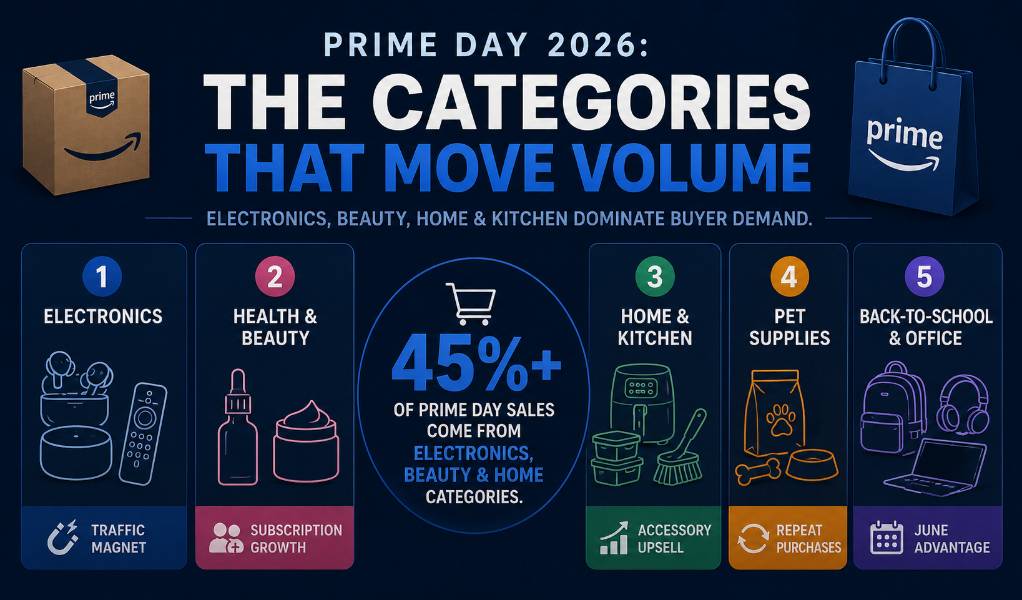
Those three categories alone represent nearly half of all event revenue. Here’s what’s actually happening inside each one and where the real opportunities sit.
Electronics
The obvious winners, Apple AirPods Pro 2, Amazon Echo Dot, and Fire TV Stick HD, generate most of the category’s headline numbers, but the margins on branded electronics are razor-thin, and the tariff exposure on Chinese-manufactured accessories is severe.
The brands consistently winning in this category aren’t the ones going deepest on price. They’re the ones running precision deals on 1–2 hero SKUs while using Sponsored Display retargeting to pull adjacent traffic.
The real Amazon Prime Day 2026 opportunity in electronics for most third-party sellers isn’t in the flagship products. It’s in accessories and ecosystem products. When Amazon pushes the Echo Dot at a loss, every Echo-compatible smart plug, smart bulb, and hub goes on a traffic surge.
Last year, Echo Dot was the #1 selling product globally during the event, and the brands that pre-bid on “Echo compatible” and “works with Alexa” keywords in Sponsored Products the week before Prime Day captured that demand without competing on price against Amazon itself.
If you’re in consumer electronics, your Prime Day PPC strategy should be bidding on the ecosystem, not just your own brand terms.
Health, Beauty & Personal Care
This is the category with the clearest Prime Day playbook right now, and COSRX is the best example of how to execute it. For Prime Day 2025, COSRX ran its biggest promotion of the year , 30% off the Advanced Snail 96 Mucin Power Essence, alongside first-ever markdowns on new launches.
The strategy was explicit: use TikTok-driven awareness (the brand had gone viral on the platform) to bring external demand to Amazon, then convert it with a time-limited deal that existing fans had been waiting for.
The result wasn’t just Prime Day revenue. It was subscriber acquisition. The brands winning in beauty treat Prime Day deals on consumables as a Subscribe & Save acquisition moment. A customer who buys your skincare serum at 25% off during Prime Day and clicks Subscribe & Save is worth 6–8x the one-time sale over 12 months. That changes the math on how deep you can go on the deal price, as you’re paying for customer acquisition, not just margin on one order.
For sellers in supplements and personal care with no viral TikTok presence, the COSRX playbook still applies: pick 1–2 SKUs with strong review velocity, run a meaningful deal (20%+ off), layer on a Subscribe & Save offer, and measure customer lifetime value, not Prime Day ACoS.
One thing health and beauty sellers specifically undervalue is sponsored brand video. In categories where before/after results matter, a 15-second video in search results outperforms static images significantly. Sponsored brand video CTR runs about 2.6x higher than static ads. For a product category where shoppers are deciding between three options with similar prices, the one with a video in the results usually wins.
Home & Kitchen
Shark and Ninja dominate the headlines, the Shark AI Ultra Robot Vacuum and Ninja Air Fryer have been top-5 Prime Day sellers two years running. But the practical lesson for third-party sellers isn’t to compete with Shark. It’s to understand that when major appliance brands drive category traffic, the entire category benefits.
The brands making real money in home & kitchen on Prime Day are the accessory and adjacent-use sellers. When a Shark vacuum is a top seller, replacement filters, vacuum bags, and cleaning solution bundles ride the same traffic wave without competing on price.
One common tactic among experienced home sellers is they run PAT (Product Attribute Targeting) ads against the top-selling hero products in your category during the week before Prime Day. You’re bidding on competitor ASINs when traffic intent is highest, the CPCs are higher than normal, but so is the conversion intent.
The other Home & Kitchen pattern worth noting: cleaning and organization products get a July lift because of two overlapping behaviors, the “fresh start” mentality that comes with summer and the back-to-college setup shopping that starts in late June. A June Prime Day accelerates that overlap. If you sell organizers, storage bins, or anything that goes in a dorm room, the June timing is actually better for you than July was.
Pet Supplies
This category is consistently underestimated by sellers who aren’t in it. In 2023, pet supplies hit $300 million in Prime Day sales, with Zesty Paws, Seresto, and Temptations leading by volume. The category has grown every year since.
What makes pet supplies unique for the Amazon Prime Day 2026 strategy is the combination of high repeat-purchase rates and strong emotional attachment. Pet owners don’t stop buying once they find a product their dog or cat likes, they subscribe and reorder forever. That makes pet supplies one of the best Subscribe & Save conversion opportunities on all of Amazon, and Prime Day is when you acquire those subscribers at scale.
The strategy that can work here is you can bundle a 30-day supply with a 90-day Subscribe & Save offer. Position the Prime Day deal as the entry point to the subscription. Zesty Paws does this across their entire chew supplement line, the Prime Day deal is priced to make the S&S option feel like the obvious choice. If you’re in the pet supplies category, then your goal is Amazon Prime Day subscriber count.
Back-to-School / Office (and why June timing matters more than sellers realize)
A July Prime Day always competed awkwardly with back-to-school shopping, so parents were in research mode, not yet in buying mode. A late-June Prime Day hits exactly when the first wave of back-to-school buying actually starts.
In 2023, Chromebooks and ergonomic chairs were best-sellers in this segment during Prime Day. For 2026, the overlap is even cleaner: parents shopping for a college freshman are making decisions in June that would have been July decisions in previous years.
If you sell anything that goes in a backpack, on a desk, or in a dorm, like laptop stands, cable organizers, desk lamps, or noise-canceling headphones, explicitly position your Prime Day deals around back-to-school in your listing copy and PPC keywords.
“Prime Day back to school deals” and “dorm room essentials Prime Day” are high-intent, lower-competition terms that most sellers in this category aren’t bidding on yet.
What to Do During the Prime Day Event
The work you do during Prime Day is mostly monitoring and reacting, not building. Here’s the short version:
Monitor inventory every 2–3 hours on Day 1
The first 24 hours are your highest-velocity period. If a product is trending toward stockout, activate your FBM/3PL overflow immediately, don’t wait for it to actually run out.
Watch your Buy Box win rate
If you’re losing the Buy Box during the event, audit your pricing first, then check if Amazon’s algorithm is flagging a price-matching issue against a competitor or retail site. During Prime Day, other retailers (Target and Walmart) run competing sales. Amazon’s price-matching bot is active and will suppress your Buy Box if it finds your product cheaper elsewhere.
Don’t panic-cut prices. Many sellers slash prices on Day 2 when they see Day 1 conversion rates below expectations. Resist this unless your data clearly shows a pricing problem. Prime Day shopping behavior is non-linear; some categories convert heavily on Days 1 and 4 with a natural trough in the middle.
Keep your external traffic channels active
Email your list on Day 1. Share your deals on your social channels. Push traffic to your storefront, not just individual product pages. External traffic during Prime Day is one of the fastest ways to improve your organic search rank because Amazon’s algorithm interprets external traffic as a high-demand signal.
What to Do After Amazon Prime Days 2026 Ends (Super Important Stuff)
You might think that Prime Day is over, but do the following things to enjoy your coffee in peace after Prime Day on Amazon.
Retarget immediately
A significant portion of shoppers who viewed your product during Prime Day didn’t buy. They were in research mode. Use Sponsored Display and DSP to retarget them within 48 hours of the event ending. “Missed Prime Day? Limited stock still available.” Messaging converts well in the 3–5 days post-event.
Don’t turn off your ads
A lot of sellers drop budgets to pre-event levels on July 12. This is wrong. The week after Prime Day has above-average traffic from shoppers who missed deals or are returning to complete research. Maintain elevated budgets for 5–7 days post-event, then step down gradually.
Analyze by ASIN, not by event total
Your overall Prime Day revenue number is interesting but not actionable. What you need to know is which ASINs had strong CVR and low ACoS (run more of these next event), which had high traffic but poor CVR (listing problem, fix before Q4); and which ran out of stock (increase inventory forecast multiplier).
Request reviews
You just acquired a lot of new customers. Use Amazon’s “Request a Review” button or a third-party tool to send review requests within 5 days of delivery. Prime Day buyers are engaged, but they’re more likely to respond to a review request than a typical customer.
Start planning for Prime Big Deal Days
Amazon has run its fall event every October since 2022. Use your Prime Day learnings, which products, which deal types, and which PPC structures performed to build a better playbook for October. The sellers who win Q4 are often the ones who treated Prime Day as a test run.
Final thoughts on Amazon Prime Days 2026
Prime Day is no longer a two-day sprint where you slash prices, pump your ad budget, and hope for the best. The event is four days long, costs are higher, the competition is more sophisticated, and Amazon’s pricing rules mean your decisions from 60 days ago already determine what you can do today.
The sellers doing well in 2026 are the ones who did the margin math in April, shipped inventory in May, built their ad campaigns 4–6 weeks out, and optimized their listings for how shoppers actually discover products now, through AI, not just keyword search.
Prime Day 2025 was the equivalent of two Black Fridays. The 2026 event is expected to be larger. That’s a significant opportunity. The question isn’t whether to participate, it’s whether you’re positioned to profit from it rather than just get revenue from it.
For Prime Day specifically, SellerApp helps sellers close the gaps that manual management can’t cover at event speed. Here is how we can help you reduce your cortisol while you are juggling between multiple things:
We have a Reverse ASIN feature that lets you pull the highest-converting keywords driving your top 10 competitors’ listings, not your guesses about what those keywords might be, but the actual terms Amazon is attributing sales to. That’s your foundation for both listing optimization and PPC targeting before Amazon Prime Days 2026 begins.
During the Amazon Prime Days 2026 event, SellerApp’s real-time business alerts flag inventory velocity changes, Buy Box losses, and ACoS spikes the moment they happen, not the next morning when you check your dashboard. During a four-day event where Day 1 alone can represent 35%+ of total volume, a two-hour blind spot can mean thousands in lost sales or wasted ad spend.
After the Amazon Prime Days 2026 event, our PPC automation tools let you harvest the new converting search terms your auto campaigns generated during Prime Day and push them directly into optimized manual campaigns with the exact keyword intelligence that pays dividends through Q4.
If your inventory is in, your deals are submitted, and your campaigns are running, you’re in good shape. If not, the moves you make in the next two weeks will determine where you land.
The post Amazon Prime Days 2026: A Complete Guide for U.S. Sellers appeared first on SellerApp Blog.
from SellerApp Blog https://ift.tt/sNKF1X8
via IFTTT
Add a review