
Amazon Selling Courses: The Smartest Way to Start and Scale Your FBA Business
Descriptions
The best Amazon selling course won’t make you the best seller on Amazon overnight, but it might stop you from losing $10,000 on the wrong product in the wrong niche with the wrong strategy.
That’s the conversation nobody wants to have upfront. Some Amazon seller courses are genuinely excellent. Others are straight-up overpriced programs designed to ride the FBA hype wave. And some sit in that frustrating middle, with decent information wrapped in outdated strategies, with a $5,000 coaching upsell waiting three clicks in.
After spending years in the e-commerce space and watching sellers make and lose real money on this platform, this guide gives you a straight look at what’s inside these courses, who they’re actually built for, and where each one falls short. No affiliate puff pieces. No recycled listicles.
If you’re ready to take Amazon selling seriously, this is where to start.
Quick Guide:
- The best courses on how to sell on Amazon right now
- Are Amazon Seller Courses Actually Worth the Money?
- What Most Amazon Selling Courses Won’t Teach You
- What should you avoid Before You Buy Any Amazon Seller Course
- Follow this checklist before spending on any Amazon seller training course
The best courses on how to sell on Amazon right now
There are dozens of courses on how to sell on Amazon floating around the internet right now. Most of them aren’t worth your money, your time, or both. The ones below are the exceptions, each for a specific type of seller with a specific set of goals.
Read the section below before you decide.
1. Amazon Seller University
- Price: Free with any Seller Central account
- Model focus: All selling models
- Who it’s for: Anyone who wants to understand how Amazon actually works before spending a dollar on anything else
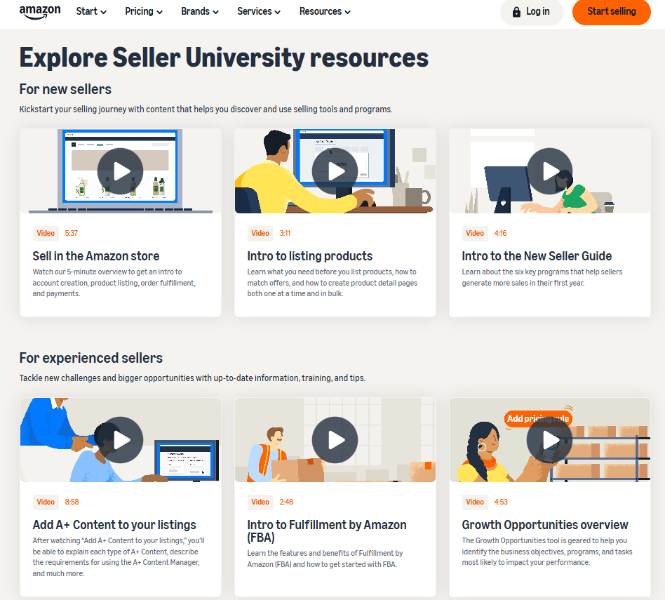
If you’re looking for an Amazon seller course free of charge, built directly by the marketplace itself, Amazon Seller University is the place to start. Amazon built this resource itself, which is precisely what makes it so useful and so underestimated by people chasing flashier options.
What’s actually inside: The content covers Seller Central navigation, account setup, FBA logistics, advertising basics, Amazon A+ content, Amazon brand registry, and compliance requirements, all from the source. It’s organized by seller level (new, growing, and brand-focused), so you’re not sifting through advanced ad content when you’re still figuring out how to create a listing. Each video focuses on a specific action and typically runs under 10 minutes, making it easy to dip in and out without losing your place.
Why it matters: The sellers who dismiss it because it’s not a “real” course are often the same ones who launch a product and discover three weeks in that they didn’t understand the fee structure, didn’t know about restricted categories, or are surprised that their first FBA shipment got rejected over a labeling error. These are avoidable problems. Amazon Seller University exists specifically to prevent them.
Spend a couple of weeks here before you spend money anywhere else. You’ll know the platform. You’ll know the terminology. And you’ll be able to spot which parts of any paid Amazon seller training course are genuinely teaching you strategy versus just rephrasing what Amazon already publishes for free.
2. Proven Amazon Course (PAC)
- Price: $39/month or $999 one-time lifetime access
- Model focus: Retail Arbitrage, Online Arbitrage, Wholesale, and Private Label
- Who it’s for: Sellers who aren’t locked into one model yet, or those starting with limited capital
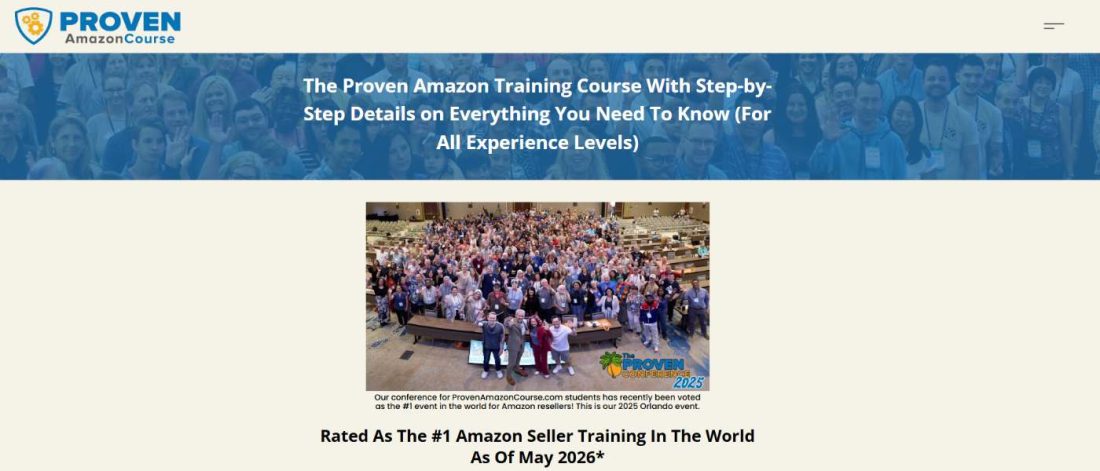
Jim Cockrum, veteran Amazon seller, author, and one of the most respected voices in the FBA community, started teaching Amazon strategies back in 2009, long before “Amazon seller training course” was even a Google search term. PAC is the accumulated knowledge of over a decade of real-world selling, organized into a library that now covers more than 40 distinct modules across every major Amazon model. Nothing else on this list covers this much ground at this price.
What’s actually inside: PAC’s most distinctive offering is the Replens model, short for “replenishable products.” Instead of chasing one-off clearance finds or rolling the dice on a brand-new private-label product, the Replens strategy teaches you to identify branded products that sell consistently on Amazon, source them reliably, and reorder them on a predictable rhythm. You’re not betting on a launch. You’re building a repeatable system.
Sellers who crack the Replens model talk about it the way people talk about compound interest: boring to describe, powerful in practice. PAC’s private Replens Facebook group has over 2,000 active members, which is unusual for a course community at this price point. Beyond Replens, the course covers retail arbitrage from scratch, online sourcing strategies for arbitrage, wholesale account setup, and a private-label track that walks you through branding, sourcing, and listing creation.
AC’s breadth is also its biggest weakness for a certain type of learner. When you log in for the first time, you’re looking at over 40 modules and dozens of presenters covering everything from selling used books to advanced private label sourcing. It can feel like being handed a library card and told, “Everything you need is in there.” Jim’s team recommends starting with the “Start Here” module and then narrowing to your chosen model, and that’s the right call. But if you need a rigid week-by-week roadmap, PAC will frustrate you before it helps you.
The core content was also last comprehensively refreshed in 2020. Some modules are current; others feel like they predate meaningful Amazon algorithm changes. That’s not a dealbreaker for foundational strategy, but it is worth knowing before you apply tactical advice to a 2026 marketplace.
PAC is the right choice for budget-conscious sellers who want maximum strategic coverage. It’s the only budget Amazon selling training course that takes retail arbitrage seriously enough to be genuinely useful.
3. Amazing Selling Machine (ASM)
- Price: ~$997 one-time (down from $4,997); monthly payment options available
- Model focus: Private Label
- Who it’s for: Complete beginners who want the most structured, hand-held FBA experience available
Who built it and why it matters: ASM was founded in 2012 by Matt Clark and Jason Katzenback, two e-commerce entrepreneurs whose backgrounds are worth understanding before you dismiss or buy in.
Matt Clark’s story is unconventional. After getting clean from drugs, he moved to Austin, started selling supplements on Amazon at 24, scaled too fast, nearly went broke, and then rebuilt from the ground up and founded three multi-million-dollar businesses. He’s gone on to sell over $267 million in products online, with a track record featured in Forbes, CNBC, and Business Insider.
Jason Katzenback took a different road: an engineering degree that didn’t stick, a corporate job that cut his bonus in 2003, and a pivot into internet marketing that eventually led him to co-launch Amazing.com. He left the company in 2015 when his daughter was diagnosed with cancer and returned after she passed away in 2018.
These aren’t polished guru bios. They’re people who built real businesses through genuinely hard circumstances, which matters when you’re trusting someone to teach you how to do the same.
The actual course delivery falls to Rich Henderson, who has been with ASM since 2013 and narrates the full curriculum, and Mike McClary, who started as an ASM student himself, quit his corporate accounting job after taking the course, and built what became a $3 million Amazon FBA business. Mike isn’t a career educator who learned Amazon from a slide deck. He went through the same course, applied it, and came back to teach it.
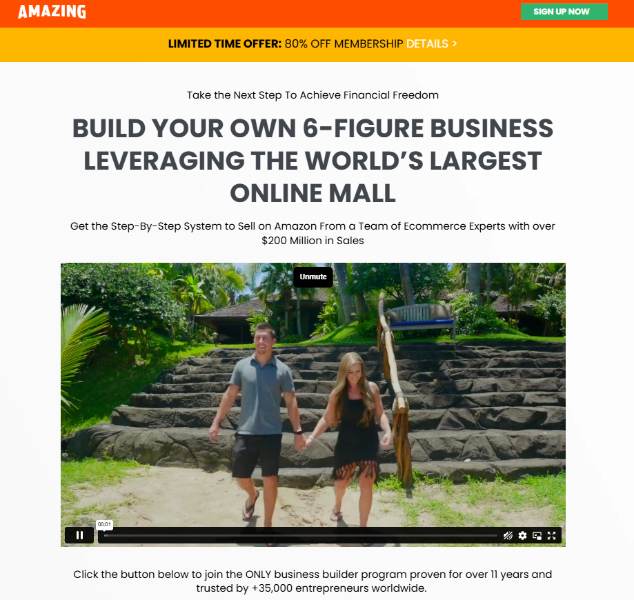
What’s actually inside: For years, ASM was the course you brought up when making a point about overpriced Amazon training. At $4,997, it was the luxury watch of FBA courses: impressive, aspirational, and genuinely hard to justify. The 2026 version, rebranded as Amazing Selling Machine AI, is now available for roughly $997, a 60% reduction that makes the community and mentorship elements worth examining seriously.
The curriculum runs across eight structured modules:
- Modules 1–3: Product research using AI-assisted tools to identify high-demand, low-competition opportunities
- Module 4: Supplier sourcing, primarily through Alibaba including negotiation scripts and sample evaluation
- Module 5: Brand building naming, packaging, and differentiation strategy
- Module 6: Listing creation copywriting, photography standards, and A+ content
- Module 7: Launch strategy and PPC setup
- Module 8: Scaling account management, inventory forecasting, and brand expansion
The production quality is genuinely excellent. Videos are clean, the interface is easy to navigate, and the progression feels deliberate. What actually separates ASM from every other Amazon online selling course on this list, though, is the community and mentorship. The private member community averages close to 6,000 interactions per week. The Platinum Mentor program pairs you with actual seven-figure sellers who review your listings, your product research, and your launch strategy in real time.
The Resource Vault adds further value, including the supplier contacts, freight companies, photographers, and negotiation templates that the course creators use themselves. Getting access to a rolodex like this as a new seller is like having a head start that most beginners spend months building on their own.
If you’ve already launched a product and understand the ecosystem, ASM won’t teach you much that’s new. One reviewer put it plainly: “The real learning happened once I started spending money on inventory and ads, not while watching the videos. ” ASM gives you structure and confidence. The edge comes from execution.
Also, the course fee is not your total investment. Plan for another $3,000 to $5,000 for inventory, PPC during launch, photography, and operating costs. Factor this in before deciding that ASM is suddenly affordable.
At its new price point, ASM is the strongest choice for someone who genuinely needs structure, accountability, and a live community of serious sellers. If you struggle with motivation without a support system around you, this course fills that gap better than anything else on this list.
4. The Wholesale Formula (TWF)
- Price: $2,997 one-time or 4 payments of $874
- Model focus: Wholesale exclusively
- Who it’s for: Sellers committed to wholesale who want a focused, proven curriculum, not a generalist overview
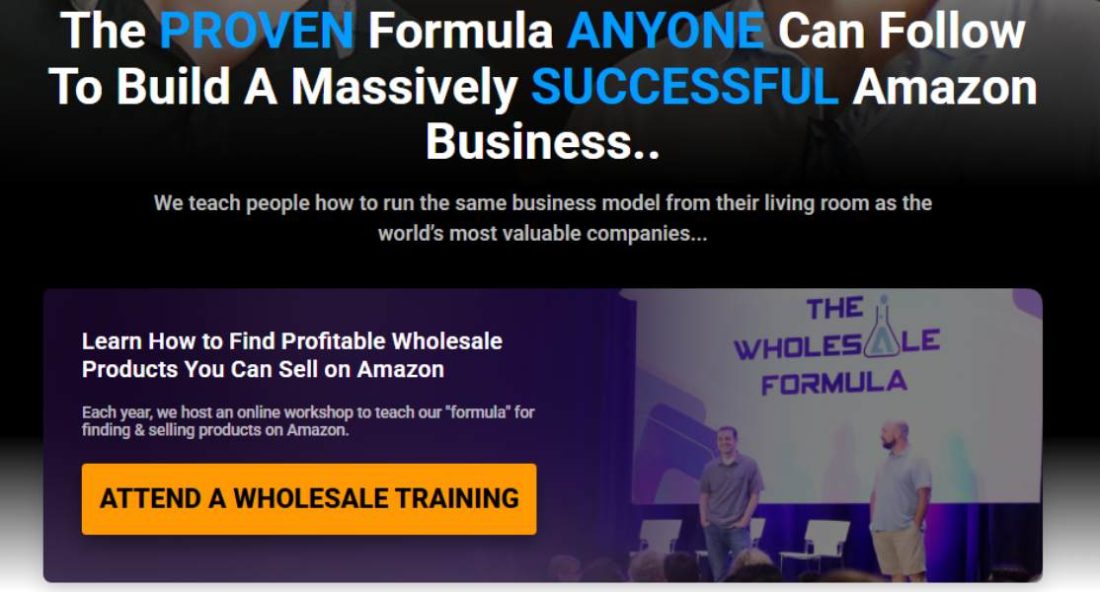
Who built it: Dan Meadors and Dylan Frost are the founders of The Wholesale Formula, and they bring the kind of credibility that’s hard to manufacture. Before creating the course, they built a wholesale Amazon business that scaled to over $25 million in sales entirely through the strategies they now teach. They’re not educators who learned Amazon wholesale from a textbook. They built the playbook themselves, then documented it.
What’s actually inside: TWF is built around one core strategy they call “reverse sourcing wholesale.” Instead of finding a supplier and figuring out what they can sell for you, you start with products already selling well on Amazon, identify the brand owners, and open a wholesale account. account directly with the manufacturer. You’re not guessing at demand; you’re following proven sales data.
The course runs across six structured modules and 90+ videos:
- Module 1: Foundations – account setup, understanding the wholesale model, and setting realistic expectations
- Module 2: Product analysis – how to evaluate Buy Box dynamics, sales velocity, and margin potential using Jungle Scout and Keepa
- Module 3: Scouting system – their step-by-step process for finding and evaluating wholesale opportunities at scale
- Module 4: Value propositions – how to pitch yourself to brand owners as a partner worth opening an account with, not just another reseller
- Module 5: Brand outreach – email templates, cold call scripts, and follow-up sequences that actually convert
- Module 6: Account management – reorder systems, cash flow management, and scaling the operation
The value proposition module deserves special mention. Most wholesale outreach fails because sellers show up with nothing to offer. TWF teaches you to walk in with optimized listings, better content, and a pitch that positions you as someone who grows the brand’s presence on Amazon, not just someone looking to undercut the competition. That module alone is worth a significant portion of the course price for anyone who’s tried and failed at wholesale outreach before.
Included bonuses that actually matter: VA Launchpad training (so you can delegate the outreach process), 60 days of coaching support, $3,000 in software discounts, and the full library of email templates and negotiation scripts.
TWF is expensive, and enrollment opens only once a year, typically in January or February. Miss the window, and you’re waiting with no workaround. You’ll also need at least $2,000 in working capital for inventory beyond the course fee.
Wholesale also demands persistence that some sellers underestimate. Brand outreach conversion rates are inherently low. You’ll hear “no” or, more often, nothing at all, far more than you’ll hear “yes” when you’re starting out. If you’re the kind of person who quits after three rejections, wholesale will break your spirit before it builds your business.
If wholesale is your model, TWF is the clearest path to doing it right. No other course comes close to this specific strategy. Get on the waitlist early, budget honestly, and accept that the first few months require patience.
5. Jungle Scout Academy
- Price: Included with any Jungle Scout subscription (starts at ~$49/month)
- Model focus: Private Label primarily
- Who it’s for: Absolute beginners who want structured fundamentals before committing to anything paid
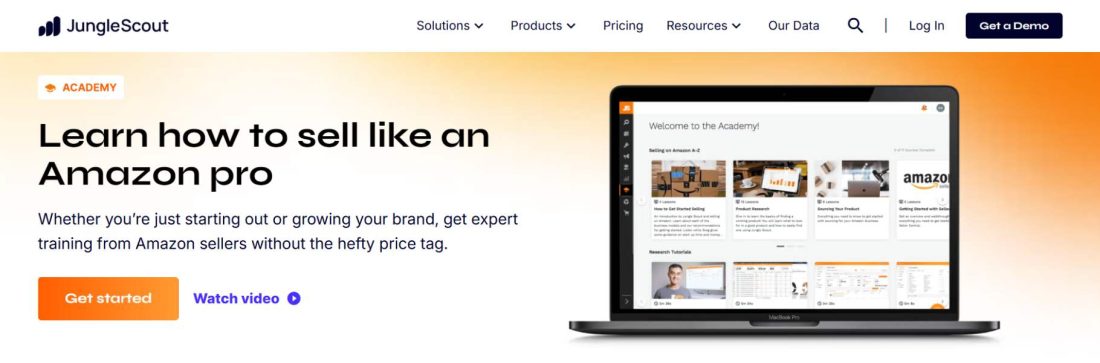
Before you spend money on any Amazon seller course, spend time here. Jungle Scout Academy is taught by Greg Mercer, the founder of Jungle Scout and a seller who built his own Amazon business to eight figures before building the tool. That pedigree matters: the training is grounded in real selling experience, not academic theory.
What’s actually inside: The Academy covers the full private label workflow product research using Jungle Scout’s Opportunity Finder and Product Database, supplier vetting on Alibaba, building a listing that converts, keyword strategy using Keyword Scout, and reading your first advertising reports. Each module pairs the concept with a live walkthrough inside the tool, so you’re learning the strategy and the software simultaneously.
Think of it as the Amazon seller course free tier that actually earns its keep. Unlike most free offerings, the Academy content is current, structured, and built around a research tool you’ll likely be using on the job. Getting training included with the subscription means your first dollar covers both.
It won’t take you to six figures on its own, but it gives you a foundation solid enough that when you do invest in deeper Amazon seller training courses, you’ll absorb twice as much because you already understand the basics.
6. Freedom Ticket by Helium 10
- Price: Free with any Helium 10 paid plan (starting at $39/month); $997 as a standalone
- Model focus: Private Label:
- Who it’s for: Beginners who want a structured, tool-integrated path into private label FBA
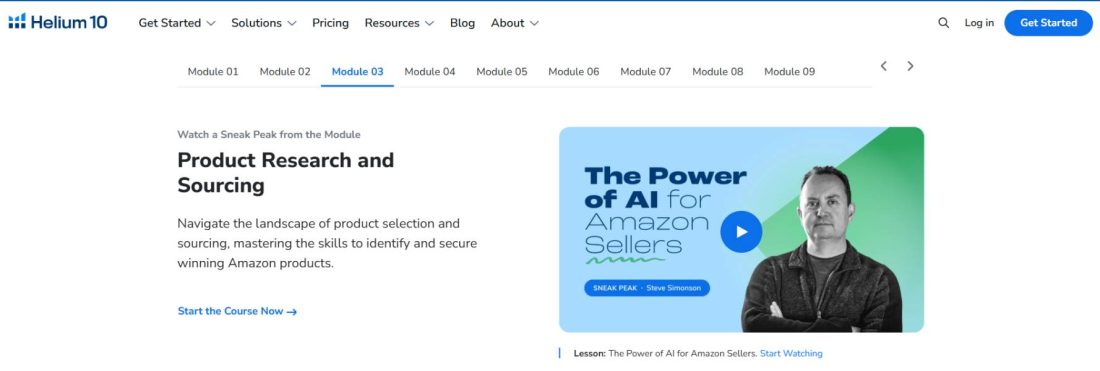
Freedom Ticket is led by Kevin King, a name that carries genuine weight in serious Amazon seller communities. Kevin has been selling on Amazon for over two decades, has launched hundreds of products, and has a track record that goes well beyond building a course. This isn’t someone who built one successful product and turned it into a teaching business.
What’s actually inside: The course runs across 10 weeks and 150+ modules, one of the most comprehensive selling-on-Amazon course structures available. Week by week, the progression looks like this:
- Weeks 1–2: Business setup – legal structure, tax basics, and Seller Central account configuration
- Weeks 3–4: Product research – using Helium 10’s Black Box tool, understanding demand signals, and spotting the red flags that kill margins
- Weeks 5–6: Supplier sourcing – manufacturer communication, sample evaluation, and first-order negotiation
- Weeks 7–8: Listing creation – keyword research with Cerebro, copywriting frameworks, and image standards
- Weeks 9–10: Launch and PPC – launch sequencing, campaign structure, and scaling ad spend once the algorithm has enough data
What sets it apart from most Amazon seller training courses is its specificity. Kevin doesn’t tell you to “find a product with good margins.” He walks you through the exact criteria he uses, shows you the numbers he looks for in the data, and explains where most sellers make their first expensive mistake in product selection. The sourcing modules are similarly detailed, covering manufacturer outreach, proper sample evaluation, and structuring a first order to minimize risk.
Serious Amazon sellers need Helium 10 anyway for keyword research, listing optimization, profit tracking, and inventory management. When you subscribe to Helium 10, Freedom Ticket comes included. You’re not paying $997 for just the training. You’re getting the training plus the full tool suite for roughly the cost of the tools alone. For anyone starting from scratch in private label, that’s a hard deal to beat.
Freedom Ticket is a private-label course. If you’re planning wholesale or arbitrage, the content doesn’t serve you as well. The community is also quieter than ASM’s. And the deep integration with Helium 10 tools means some walkthroughs won’t translate directly if you’re using a different tool stack.
For someone starting from zero in private label, this is the closest thing to a complete starting package on the market. High course quality, genuinely useful tools, and better value than almost anything else on this list when accessed through a Helium 10 plan.
Are Amazon Seller Courses Actually Worth the Money?
The honest answer is that it depends entirely on which course and model you are using and where you are in your journey.
What we understood is the business of selling Amazon seller courses is frequently more profitable than the Amazon business those courses claim to teach. A seller who builds to $50,000 in FBA revenue per month has done something genuinely hard.
A course creator who sells 500 seats at $997 has done something much easier and captured similar revenue. That doesn’t mean the course is bad, but it does mean you should hold the purchase to a higher standard than you might hold a Netflix subscription.
A course earns its price when you’re starting from scratch, and the cost of learning through pure trial and error, in failed inventory, wasted PPC spend, and time, would far exceed the course fee.
It earns its price when the community gives you access to people further along the path who can save you from mistakes you didn’t know you were about to make. And it earns its price when you treat it like a business investment, not entertainment, meaning you actually apply what you learn immediately, not someday.
A course doesn’t earn its price tag if you haven’t yet gone through Amazon Seller University and Jungle Scout Academy for free. When the instructor’s own Amazon sales data is from three or four years ago.
When you’re buying it because the urgency timer is about to expire, not because you’ve thought the decision through. And it definitely doesn’t earn its price when you buy it, watch 40% of it, and move on.
What Most Amazon Selling Courses Won’t Teach You
Here’s where things get real. You can go through a course, follow every module, and take all the notes in the world, and still get blindsided in your first year because the curriculum stops where the hard stuff begins. You need to know them before you spend a dollar on inventory.
The Coaching Upsell Feature
Almost every paid course has a premium coaching tier waiting behind the content $4,000 to $10,000 for “personalized” access. The problem is that course quality and coaching quality don’t always travel together. The coach you get matched with might be a community moderator who completed the course six months ago, not the seven-figure seller whose photo is on the sales page.
Before you agree to any coaching upsell, ask point-blank: Who specifically will be coaching me? Can I speak with them before I commit? What are their current, verifiable Amazon sales numbers?
If you want a smarter alternative, SellerApp’s Seller Intelligence tool is worth checking out. It lets you research any Amazon seller’s performance data, revenue estimates, product portfolio, sales velocity, and category trends, which means you can actually verify whether the coach or instructor you’re considering is actively running a real Amazon business, not just teaching one. That’s the kind of due diligence that most sellers skip and then regret.
If the answers to your questions are vague, that is your answer.
What Your Real Startup Budget Looks Like
Most how-to-sell-on-Amazon course sales pages say you can start private label with $2,000 to $5,000. The reality for a properly resourced first product, the kind that has a real shot, looks more like this:
- Product samples: $100–$300
- First inventory order (500 units): $1,500–$4,000 depending on the product
- Sea or air freight: $500–$1,500
- Product photography: $300–$800
- Amazon PPC during the first 60 days of launch: $500–$2,000 minimum
- Operating buffer before profitability kicks in
Add it up, and $8,000 to $15,000 is the honest starting number for private labels with a real chance of success. Build your financial plan around that number, not the headline on a sales page.
Account Suspension can turn out to be a business risk
Most courses spend one module on compliance and call it done. Experienced sellers will tell you the most critical skill they learned, and learned the hard way, was how to protect their account health before a problem ever surfaced.
Understanding restricted categories, managing your order defect rate, writing a suspension appeal that actually works, and maintaining clean account health metrics are not advanced topics.
They’re the foundation of a business that survives long enough to be worth running. Learn this before you launch. Not after your account gets flagged.
Your business is a commercially viable asset
Here is something that essentially no Amazon online selling course touches because it doesn’t serve the “get rich on Amazon” narrative: your FBA business can be sold. Amazon businesses typically sell for two to four times their annual net profit on marketplaces like Empire Flippers and Flippa.
A seller doing $5,000 in net profit per month with clean books, a healthy account, and a well-documented process could realistically exit for $120,000 to $240,000. Most sellers don’t know this when they’re starting.
If you build your business from day one with a clean LLC structure, organized financials, and strong account health, with an eventual exit in mind, you’re building something that pays you twice: once while you run it and again when you sell it.
How you should Budget for the Tool Stack
Courses recommend tools because they have affiliate deals. What they don’t give you is the actual monthly cost.
A realistic tool budget for a serious Amazon seller includes Helium 10 or Jungle Scout, Keepa, a Amazon PPC management tool, and potentially a repricing tool, running $200 to $400 per month before you’ve made a single sale.
That’s $2,400 to $4,800 per year. It belongs in your startup plan. Don’t let it blindside you in month two.
What should you avoid Before You Buy Any Amazon Seller Course
Here’s what to check before you start with any Amazon seller courses:
The instructor’s income screenshots are years old
Amazon in 2021 was a different market. If someone can’t show you current, verifiable results from their own selling account, their advice may be built on a playbook that no longer works.
The course hasn’t been meaningfully updated
Amazon changes constantly: fees, algorithm behavior, and policy enforcement. A course with foundational content from 2020 might still have value, but tactical advice needs to be current. Check when the course was last updated, not when it was created.
The refund policy is packed with conditions
A clean 30-day, no-questions-asked refund policy is the baseline. Fine print like “refund only applies if you’ve completed X modules” or “you must show proof that the strategies didn’t work” is a red flag. Confident course creators don’t need escape hatches.
The course claims to cover every model equally well
No serious Amazon selling course does this. Breadth and depth don’t coexist naturally in a single training program. When a course claims to be equally good at private label, wholesale, and retail arbitrage, it usually means it goes a mile wide and an inch deep in each.
How to Pick the Right Amazon Seller Course for Your Situation
By this point, you’ve seen what’s actually inside these courses, who they’re built for, and where they fall short. Now the question is simple: which one fits your situation? So instead of telling you which course is “the best,” here’s a straight decision framework based on where you actually are right now.
When you have zero budget
Amazon Seller University, then Jungle Scout Academy. Both are free and useful. You’ll come out knowing more than most people who paid $500 for a beginner Amazon seller training course.
You have under $100/month and aren’t sure which model you want
Proven Amazon Course. Maximum strategic coverage, flexible access, and cancel when you’ve got what you need.
You’re committed to wholesale specifically
The Wholesale Formula, without question. Get on the waitlist early. Budget at least $2,000 for inventory, in addition to the course fee.
You need structure, accountability, and a real community to stay on track
With the Amazing Selling Machine. The new price makes the mentorship and community access genuinely worth considering for the right person.
One practical move almost nobody talks about: before you buy any paid course, find its public Facebook group or Reddit thread and lurk for two weeks. Read what students are actually struggling with.
If the common complaints are about motivation or execution, the course is probably solid, and people just aren’t doing the work. If you’re seeing consistent complaints about outdated content, unresponsive support, or promises not delivered, that’s your real review, far more honest than anything on the sales page.
Follow this checklist before spending on any Amazon seller training course
If you’re eyeing courses on how to sell on Amazon but aren’t sure where to begin, follow this checklist before opening your wallet:
Week 1: Platform Literacy
Complete Amazon Seller University. Understand FBA vs. FBM, the full fee structure, and how Seller Central is organized. Dry, but critical.
Week 2: Model clarity
Sit with the three selling models and make an honest decision based on your available capital and risk tolerance. Don’t skip this.
Week 3: Real-world grounding
Watch 15 to 20 hours of YouTube content from active sellers (not course promoters) in your chosen model. Helium 10’s YouTube channel and Jungle Scout’s blog are legitimately good free resources.
Week 4: Community Intelligence
Join two or three active Facebook groups or subreddits for your model. r/AmazonFBA is a good choice. Lurk. Ask questions. See what real sellers are dealing with right now in 2026.
Month 2: Buy with intention
By now, you’ll know exactly what you understand, what you don’t, and which Amazon seller course fills the actual gaps in your knowledge.
You’ll get significantly more value from a paid course at this point than you would have in week one, because you have enough context to apply what you’re learning in real time.
The sellers who take this route don’t just save money. They get more out of whatever course they eventually buy, because they’re not learning the vocabulary and the strategy simultaneously.
Final thoughts
is not the gold rush it was in 2017. The competition is sharper. The fees are higher. The algorithm rewards sellers who know what they’re doing, not just sellers who got there first.
A good Amazon selling course compresses your learning curve and saves you from the expensive mistakes most beginners make in their first year. But it doesn’t do the work for you, and no amount of course content makes up for a wrong product decision, a thin margin, or a supplier who ships defective units.
The best Amazon seller course is the one that matches your model, fits your budget, teaches current strategies, and that you’ll actually finish and apply.
Counterintuitively, starting free and buying later once you know exactly what you need tends to produce better results than buying the most impressive Amazon selling training course upfront and hoping it answers every question.
The post Amazon Selling Courses: The Smartest Way to Start and Scale Your FBA Business appeared first on SellerApp Blog.
from SellerApp Blog https://ift.tt/mGHaLU1
via IFTTT
Add a review