
Amazon Scaling Risk Management: A 2026 Guide for Mid-Market and Enterprise Sellers
Descriptions
Amazon scaling risk management is the practice of identifying and controlling the operational, compliance, and structural risks that intensify as a seller’s revenue, ASIN count, and headcount grow. It covers account health, documentation, access control, and channel dependency, not just isolated fixes after something breaks.
Here’s the part nobody tells you before you cross seven figures on Amazon. The same automated systems Amazon uses to catch counterfeiters, hijackers, and policy abusers also watch order volume, pricing changes, listing edits, and review velocity, and those systems don’t have a separate, gentler ruleset for a seller who’s growing quickly for entirely legitimate reasons. A seller doing $30K a month with three SKUs and a handful of reviews is invisible to most of Amazon’s enforcement algorithms. A seller doing $300K a month across 40 ASINs, three warehouses, and a growing ad budget looks completely different to those same systems. More order volume means more chances to trip an order defect rate threshold. More SKUs mean more chances for a listing to get auto-edited or suppressed. More people touching Amazon Seller Central means more chances for a compliance gap nobody notices until Amazon does. Scaling risk management means matching your monitoring effort to that exposure, like checking account health weekly instead of monthly once order volume climbs, and assigning an actual owner to documentation and access once more than one or two people touch the account. This article covers the standard risks every seller needs to manage and the ones that only show up once you’re actually scaling.
Quick Guide:
The account health metrics that decide whether you keep selling
Every risk conversation on Amazon eventually comes back to the Account Health Rating (AHR), a score from 0 to 1,000 that every seller account carries.
New accounts start at 200.
From there, the score moves up or down based on policy compliance and performance over a rolling 180-day window.
| Zone | Score range | What it means |
| Healthy (green) | 200–1,000 | The account is not at risk of deactivation |
| At risk (yellow) | 100–199 | Amazon may restrict selling privileges |
| Unhealthy (red) | 99 or below | The account is eligible for deactivation or already deactivated |
The metrics feeding that score matter more at scale, not less. The order defect rate has to stay under 1%. The late shipment rate has to stay under 4%. The valid tracking rate needs to sit above 95% and On-Time Delivery above 90%. Here’s roughly what that costs you. Amazon deducts somewhere between 2 and 8 AHR points per policy violation depending on severity (low, medium, high, or critical), and a critical violation, like a suspected counterfeit or IP complaint, can drop the score straight to zero regardless of your prior standing. You get points back too. Roughly 4 for every 200 orders fulfilled cleanly in the trailing 180 days, which is why a high-volume account can absorb one violation that would sink a smaller one. Amazon doesn’t publish an exact formula, so treat these as directional, not a guarantee. At low volume, a couple of bad orders barely move these numbers. At high volume, the same percentage represents hundreds of actual orders, and a single bad batch from a new 3PL or a single week of missed handling times can tip a metric from comfortable to flagged within days. This is why sellers who were perfectly compliant at $50K a month sometimes get their first warning at $500K a month. Nothing about their standards changed. The math did.
The suspension triggers hitting scaling sellers hardest in 2026
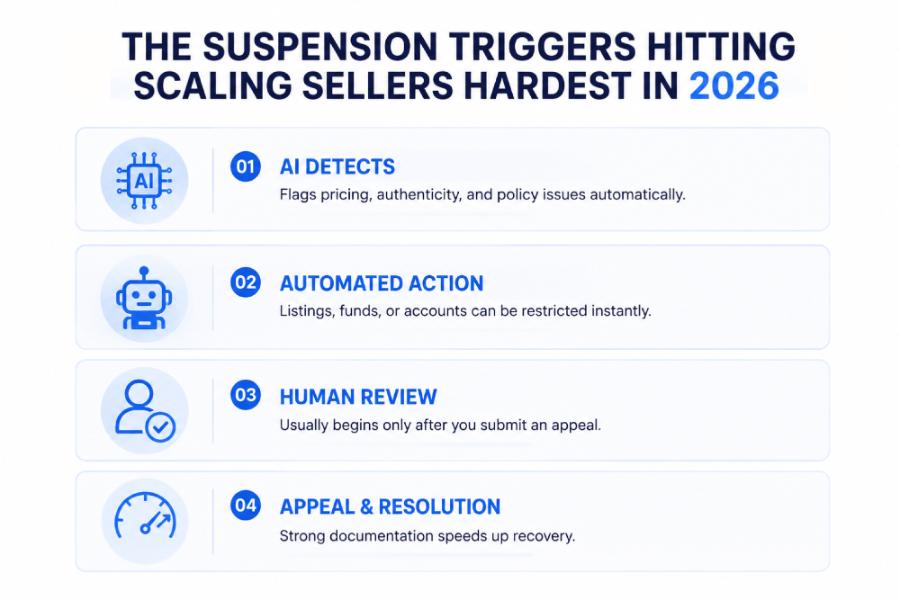
Amazon’s enforcement in 2026 runs on an AI-first model. Automated systems flag pricing anomalies, authenticity concerns, and policy gaps, then act immediately, which in practice means suppressing the listing, withholding disbursed funds, restricting selling privileges on the affected ASIN, or deactivating the account outright, depending on severity. Human review typically only happens once a seller appeals, which means the first real conversation with a person at Amazon often happens after the damage is already done. This is precisely why scaling risk management has to be preventative rather than reactive, by the time a human at Amazon is reading your appeal, the ASIN has usually already lost sales, ranking, or both. Four categories of risk show up in almost every scaling seller’s story at some point.
Automated listing edits
Amazon’s system can shorten titles, rewrite bullets, or suppress images to enforce policy, often with no meaningful notification. A title that gets quietly cut from 200 characters to 80 can lose the keywords driving a large share of its organic traffic, and a seller managing dozens of SKUs may not catch it for weeks.
Documentation requests on tight deadlines
Sellers report getting requests for supplier invoices, authenticity proof, or compliance certificates with 24- to 48-hour turnaround windows, sometimes landing late on a Friday with a Monday deadline. A seller with organized, ASIN-tagged documentation clears this in an hour. A seller who has to email three different suppliers to track down a 2024 invoice does not.
Hidden fee creep
Storage surcharges, prep costs, and return processing fees have all climbed since 2023, and they compound quietly. A product with a healthy margin on paper can lose a third of its profit to stacked fees that never show up as a single obvious line item.
Tariff volatility on imported goods
Tariffs on Chinese imports spiked as high as 145% in early 2025 before settling into a 30-40% range for many categories by mid-year, and that range is not guaranteed to hold. Sellers sourcing from a single country carry that entire risk alone; sellers who’ve diversified sourcing across two or more countries have room to absorb a spike without repricing overnight. None of these four risks is unique to any one seller size. What changes at scale is exposure. A seller with 500 ASINs across three fulfillment methods and two sourcing countries has dramatically more surface area for any one of these to hit than a seller with 12 ASINs and one supplier.
What happens to your revenue on the day Amazon suspends your account
The strongest Amazon-only brands still carry one structural risk that no amount of compliance work fixes.
If Amazon suspends the account, the business stops that day, in full, regardless of how clean the seller’s record was up to that point.
This is why the most resilient mid-market and enterprise sellers treat Walmart, TikTok Shop, and their own DTC site less like growth channels and more like insurance policies. TikTok Shop alone reached roughly $33.8 billion in global GMV in 2025 and is on pace to approach $50 billion in 2026, and younger shoppers increasingly discover products there before ever searching Amazon.
None of that means every brand needs to run three channels well, starting tomorrow. It means the brand that’s Amazon-only by choice should be able to explain why, not just default to it because it’s familiar.
In risk management terms, this is exposure at the business-model level rather than the account level, and it belongs on the same risk register as ODR or documentation readiness, because it’s the one risk that a clean compliance record can’t offset.
The scaling risks nobody puts in the standard risk list
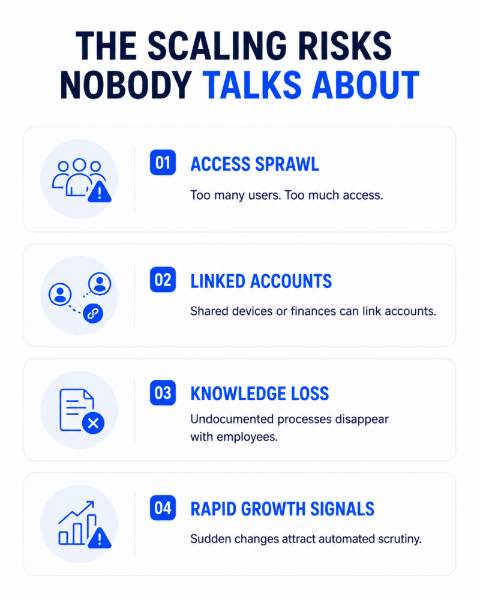
Most “risk management for Amazon sellers” content stops at account health, compliance documents, and diversification. Those are real risks. They are also the ones every competitor already covers. The risks below rarely show up in that conversation, and they tend to hit precisely the sellers this guide is written for: brands scaling past the point where one founder can personally touch every listing.
Access sprawl is its own risk category
As a brand scales, it’s common to have a Amazon PPC agency, a listing optimization freelancer, a compliance consultant, and one or two in-house hires, all needing some level of Seller Central access. Most sellers hand this out through secondary user permissions, the same mechanism used for full-time employees. The problem is that secondary users can often see and export more than the relationship justifies, and offboarding is rarely clean; a contractor’s access frequently outlives the contract by weeks or months. Amazon’s Solution Provider Portal exists specifically to formalize third-party relationships through scoped, API-based permissions instead of broad account access, and sellers managing real revenue increasingly treat the choice of which model to use as a deliberate governance decision, not an administrative afterthought.
Spinning up a second brand can quietly link your accounts
Scaling sellers often want a second account to separate product lines, enter a new category under gated restrictions, or run a wholesale arm alongside retail. Amazon allows this with a legitimate business reason. What trips sellers up is more mundane, like the same laptop used to log into both accounts, the same home address on file, a shared bank account before the new LLC’s finances are fully separated, or a contractor who logs into both on the same device. Any of these can get accounts flagged as “related,” and Amazon’s policy is blunt about what happens next: if one linked account is suspended, the others are often suspended right alongside it, regardless of their individual standing. Sellers planning a second entity get far more mileage from separating logins, devices, and finances on day one than from writing a strong appeal later.
Institutional knowledge walks out the door faster than most brands plan for
The average tenure for an in-house Amazon manager runs somewhere around 18 to 24 months, which means most scaling brands will lose their most Amazon-literate employee at least once during a serious growth phase. When that happens without documented SOPs, a change log, or a second person who understands the account’s history, the brand doesn’t just lose a hire. It loses the context behind every pricing decision, every appeal that’s been filed, and every quirk of that specific account. This is a real reason some brands deliberately keep a second person, whether an agency or a second in-house hire, in the loop on account health even when one person could technically handle it alone day to day.
The pace of change is itself a signal that Amazon’s systems watch
Sellers tend to think of risk purely in terms of violations: did I break a rule, yes or no? But Amazon’s automated systems also weigh velocity. A sudden jump in listing volume, a fast series of price changes, or a rapid spike in sales on a previously slow Amazon ASIN can read as a pattern worth scrutinizing, even when every individual action is fully compliant. A brand doubling its catalog in a month or pushing an aggressive PPC-driven sales ramp should expect a bit more automated attention during that window, not because anything is wrong, but because rapid change is exactly the kind of pattern these systems are built to notice.
Building a risk register instead of waiting for the next Seller Central alert
Most brands manage Amazon risk the same way they manage a leaky roof: they patch whatever failed most recently. A simple risk register, reviewed on a set schedule, turns that reactive habit into an actual system.
| Risk category | Owner | Review cadence | Early warning signal |
| Account health (ODR, LSR, AHR) | Ops or account manager | Weekly | Any metric within 20% of its threshold |
| Documentation readiness | Compliance or ops lead | Monthly | Retrieval time over one hour for any core document |
| Access and permissions | Founder or ops lead | Quarterly | Any active login unaccounted for in an audit |
| Sourcing and tariff exposure | Supply chain lead | Quarterly | Single-country dependency above 70% of COGS |
| Channel dependency | Growth or marketing lead | Quarterly | Amazon above 90% of the total revenue |
| Ad spend efficiency | PPC lead | Monthly | TACoS is trending up while ACoS looks stable |
That last row matters more than it looks. A lot of scaling sellers watch ACoS closely and miss the bigger picture. ACoS only measures ad-attributed sales against ad spend, so it can look perfectly healthy even while total ad spend creeps up and organic sales quietly stagnate. TACoS, which compares ad spend to total revenue, including organic, is the number that actually shows whether a brand is building durable, less Amazon-ad-dependent sales or just renting more and more of its own search results every quarter. For a mature product line, a TACoS that isn’t trending down over time is its own kind of risk, even if every individual PPC campaign looks fine on its own.
Final thoughts
Risk management on Amazon isn’t a one-time audit you run before Q4 and forget about until next year. For brands doing real volume, spending real ad dollars, and running real teams, it’s closer to a second operating system sitting underneath the growth plan. The brands that keep scaling without a suspension scare aren’t the ones with zero risk. They’re the ones who built a system to catch it early.That’s the exact gap SellerApp works with mid-market and enterprise Amazon sellers to close, connecting account health signals, PPC efficiency, and catalog-level data in one place instead of forcing your team to check five different dashboards to answer one question. If you’re scaling past the point where gut feel and a spreadsheet can keep up, talk to SellerApp about what a risk-aware growth plan looks like for your specific account. SellerApp’s full account management is the best place to start.
FAQs
How fast can Amazon suspend a fast-growing seller account?
Amazon’s automated systems can suppress a listing or restrict an account within hours of detecting a policy or authenticity concern. Human review typically happens only after a seller files an appeal, so the first real conversation with a person often comes after sales have already stopped.
What is Amazon’s Account Health Rating and how is it scored?
AHR is a 0 to 1,000 score reflecting policy compliance and performance over a rolling 180-day window. Accounts start at 200. Scores above 200 are considered healthy, 100 to 199 are “at risk,” and scores below 100 put an account at real risk of deactivation.
What documents should a scaling seller keep ready at all times?
At a minimum, supplier invoices from the last 12 months, brand authorization letters, business registration and tax documents, proof of authenticity, and any relevant safety or compliance certificates. Organize these by ASIN rather than by supplier, since that’s how Amazon’s requests are typically structured.
Do tariffs still affect Amazon sellers importing from China in 2026?
Yes. Tariffs on Chinese imports spiked as high as 145% in early 2025 before settling into a more manageable 30-40% range for many categories, but that range isn’t guaranteed to hold. Sellers relying on a single sourcing country carry more exposure than those who’ve diversified across two or more.
Is multi-channel selling necessary for risk management, or is Amazon enough?
Amazon-only is a valid business model, but it carries full platform dependency. If the account is ever suspended, the entire business stops that day. Multi-channel presence, even a modest DTC site or a Walmart listing, functions as insurance against that single point of failure rather than as an additional growth project.
Should I use Seller Central secondary users or the Solution Provider Portal for agencies?
It depends on how many outside parties touch your account and how sensitive the access is. Secondary users work fine for a small, stable team. Once multiple agencies, freelancers, or contractors are involved, scoped access through the Solution Provider Portal reduces the risk of stale logins and unclear accountability.
What is “linked account” risk, and how does it affect sellers running multiple brands?
Amazon can flag two accounts as related if they share logins, devices, IP addresses, bank accounts, or business addresses, even when each account has a legitimate reason to exist separately. If one linked account is suspended, related accounts often get suspended too, so separating finances, devices, and logins from the start matters more than a strong appeal after the fact.
Should scaling brands hire an in-house Amazon manager or use an agency?
Both work, but each carries a different risk. In-house hires average 18 to 24 months in the role, which creates institutional knowledge risk if nothing is documented. Agencies reduce turnover risk but require clear access governance. Many mid-market brands land on a hybrid: an in-house owner supported by specialist agency execution.
Is TACoS or ACoS the better metric to watch as ad spend scales?
TACoS. ACoS only measures ad spend against ad-attributed sales, so it can look stable even as total ad spend rises and organic sales stagnate. TACoS compares ad spend to total revenue, making it the better signal for whether growth is becoming more or less dependent on paid traffic over time.
The post Amazon Scaling Risk Management: A 2026 Guide for Mid-Market and Enterprise Sellers appeared first on SellerApp Blog.
from SellerApp Blog https://ift.tt/LNFl6Q0
via IFTTT
Add a review