
Amazon Rufus Ads: What They Are, Who They Are For, and How Sellers Can Win.
Descriptions
Amazon Rufus Ads pins a drastic shift in how Amazon sellers get visibility. As online shopping moves from keyword search to conversational discovery, old-school Amazon advertising tactics are starting to take a back seat.
The problem is that most Amazon sellers and campaign managers still optimize for keywords, even after seeing a repetitive pattern of shoppers asking full questions like “Which sunscreen doesn’t make my skin oily and cause pimples?” instead of typing short search terms like “Non-Comedogenic Sunscreens”.
Rufus Amazon Ad is designed to bridge the gap between sellers and shoppers’ internet language. Rufus, an Amazon AI shopping assistant, subtly recommends ads that appear directly within the chat box. This helps sellers surface their products based on the seller’s intent, context, and relevance rather than just keywords.
This article talks about what Amazon Ads Rufus are, how they work, who they are actually for, who should wait, and how Amazon sellers can brace themselves for a blooming e-shopping experience that is becoming decisively conversational.
Quick Guide:
- What Is Amazon Rufus? What Are Amazon Ads Rufus and How Do They Work?
- Organic vs Sponsored Results in Amazon Rufus
- How are Amazon Rufus Ads Filtered for Product Recommendations?
- How Is the Amazon Rufus Ads Bidding Model Any Different From the Existing One?
- What Performance Metrics Really Matter?
- Who Should Wait Before Bidding on Amazon Rufus Ads?
- Amazon Rufus Ads vs Sponsored Products vs Sponsored Brands (A Deep Dive into the Amazon Advertising Funnel)
- Run Ads on Amazon Rufus Wisely and What Sellers Are Still Wondering About?
- Challenges With Amazon Ads Rufus and How Sellers Can Solve Them
- Final Thoughts: Preparing for a More Conversational Amazon
What Is Amazon Rufus? What Are Amazon Ads Rufus and How Do They Work?
Rufus is Amazon’s AI shopping assistant built directly into the Amazon app experience. Fundamentally, Amazon Rufus functions more like a chatty, knowledgeable shopping assistant than a conventional search bar.
The role of Rufus is to listen shopper’s questions, interpret intent, and then surface or recommend relevant products within the conversation itself. For sellers, this is very important as visibility inside Rufus is driven by how well the product aligns with the shopper’s question. Not just the product’s keywords.
On the other hand, Amazon Ads Rufus, while still in beta, is a new ad format that places a product’s ads directly inside AI-led conversations.
It’s less of “who bids the most,” and more “Who fits the question”. Though the shift is subtle, it is very important.
Instead of scrolling endlessly through search results, shoppers can ask real questions. For example:
- Which running shoes are good for beginners?
- What should I look for in a beginner skincare routine?
- What kind of protein powder is best for muscle recovery?
- Amazon Rufus responds with explanations, comparisons, and product suggestions.
And rather than showing up as separate search results, Amazon Rufus ads are gently woven into a chat box where shoppers ask product-related questions, and Rufus recommends a list of products that address the shopper’s intent.
For example, when a shopper asks, “What sunscreen won’t make my skin oily and dull?” Rufus generates a response that may include product recommendations.
An important thing to ponder is that some of these recommendations are organic, while others are clearly labeled as advertisements.
Organic vs Sponsored Results in Amazon Rufus
Of course, not everything you see in Rufus is paid. Rufus blends organic and sponsored results. Organic visibility depends on listing relevance, review strength, performance history, and alignment with conversational queries.
Sponsored visibility depends on ad eligibility, bid competitiveness, and relevance alignment.
This blending is important because ad spend alone does not guarantee placement. If your listing reads like a keyword spreadsheet, ads on Rufus may not prioritize it, even if you are bidding.
A helpful way to think about Amazon ad Rufus is to compare it to influencer marketing.
When an influencer creates content, some product mentions are organic, and others are sponsored, but both appear within the flow of the conversation. Rufus operates similarly.
Sponsored placements are labeled, but they are woven into AI-generated recommendations, making relevance more important than interruption. Clear communication matters.
How are Amazon Rufus Ads Filtered for Product Recommendations?
Unlike keyword-heavy placements, Amazon Rufus operates at a semantic level. It attempts to understand what the shopper actually needs. This essentially means listings written in a natural, problem-solving language align better with conversational queries that the shopper asks.
The product is going to be the same, but the change is in the matching logic. This change is because Rufus decides what to surface by interpreting shoppers’ questions. It doesn’t focus on isolated search terms. It evaluates intent and context to surface a product based on multiple relevance and performance signals that include
- Listing relevance and clarity
- Product features and use cases
- Reviews and ratings
- Historical performance signals
- Bid competitiveness
Cost Structure: How do You Pay?
Similar to other forms of Amazon Advertising, Amazon Ads Rufus also operates on a cost-per-click (CPC) model, similar to Sponsored Products.
You are charged when a shopper clicks the sponsored recommendation and lands on your product detail page.
How much does it cost to run Rufus Amazon Ads?
The auction system still applies to ads on Rufus. Sellers proceed to bid on Sponsored Products or Sponsored Brand campaigns, and pricing is determined by a second-price auction.
This being said, Amazon ads to Rufus placements are intent-driven and hence, cost efficiency often depends more on relevance than aggressive bidding.
In initial testing, sellers typically see CPCs within the same range as any mid-funnel sponsored products, which is often between $0.80 and $1.50, depending on competition and category.
In simpler terms, you are still bidding. But in Rufus Amazon ads, relevance plays a vital role in whether the bid ever becomes eligible for placement.
How Is the Amazon Rufus Ads Bidding Model Any Different From the Existing One?
The underlying auction framework remains familiar. What changes is how placements are triggered. Traditional Sponsored Products allow:
- Keyword targeting
- ASIN targeting
- Category targeting
Rufus Amazon Ad relies more heavily on AI-driven contextual matching. Sellers may not have control over selecting “Rufus placement” specifically, especially during beta. Instead, eligible campaigns may surface in Rufus Amazon ads inventory when alignment conditions are met.
So, while your bidding structure stays similar, targeting becomes more automated and intent-based. Less manual precision. More contextual interpretation.
Example:
Consider hypothetically, a seller running a Sponsored Product Campaign for a $39.99 non-stick frying pan.
- The seller bids $0.90-$1.20 CPC on keywords like “non-stick pan” and “easy to clean frying pan.”
- The listing is optimized with buyer-centric language and clear everyday use case.
- The product maintains a 14-16% conversion rate with a 4.4-star rating.
Now, a shopper asks Rufus, “Which pan is good for everyday cooking and easy cleanup?”
The product becomes eligible for the suggestion because the shopper’s query aligns with the seller’s listing. Its history of consistent performance signals relevance, and the campaign is still active with competitive bids.
If the same product that addressed the customer’s query accurately had weak listing clarity or a low conversion rate under 7%. It would be ineffective as higher bids alone wouldn’t guarantee Rufus Amazon ads’ visibility.
Sellers’ Cheat Sheet Strategy To Target Rufus Placements
You do not typically treat Rufus the way you target an exact-match keyword. Instead, you can earn visibility inside Rufus by intent alignment across content, structure, and performance signals.
Here’s how sellers can gradually create that alignment.
Instead, visibility inside Rufus depends on alignment across:
1) Building Conversational Keyword Clusters
Shoppers usually won’t search for a single keyword. When they ask for a suggestion from Rufus, it is generally a group query.
How to do it?
- Find long-term search terms from search term reports, Q&A sections, and product reviews.
- Group them by intent, not by wording.
Example Keyword Clusters:
(For a cookware product)
- Pan that won’t stick
- Non-toxic cookware for daily cooking
- Easy to clean frying pan.
Where to include such clusters?
- Product title – Keep it natural. Don’t stuff keywords.
- First two bullet points
- In product description and A+ content.
2) Rewrite Listings in Buyer Language (Not SEO Language)
Rufus responds better to listings that sound like answers, not product catalogs. Your listings should sound more like you anticipated the functional issues of your product and are presenting a solution.
How to do it:
- Replace technical phrasing with problem-solution language
- Write bullets as if you are responding to a customer’s question
Instead of:
“Premium stainless steel kitchen utensil set”
Use:
“Durable kitchen tools that won’t bend or rust with daily cooking”
Where to include this:
- Bullet points
- Product description
- Image callouts
3) Ensure Campaign Eligibility and Competitive Bids
Amazon Ads Rufus still relies on Amazon’s ad auction.
What to check:
- Product is eligible within Sponsored Products or Brands campaigns
- Bids are competitive enough to enter placements
- Campaigns are not overly restricted by negatives
Remember, Rufus visibility won’t happen if your campaigns never enter the auction in the first place.
4) Strengthen Reviews and Performance Signals
Rufus leans on trust signals when surfacing recommendations. Having solid customer reviews and ratings increases your chances of appearing when the shopper is searching for a reliable product.
What matters most?
• Consistent conversion rate
• Stable review volume and ratings
• Low return rates
If shoppers click but don’t convert, Rufus flags it quickly. You target intent indirectly through clarity and structure. Not just using keywords.
What Performance Metrics Really Matter?
Traditional PPC metrics still apply to Amazon ads Rufus, but they need to be handled differently. Rufus works within a conversational, mid-funnel environment where shoppers are exploring options. Their immediate action may not be to make a purchase.
Not every interaction is meant to convert. A metric that looks weak in key-word focused campaign may still indicate healthy intent coordination in Rufus. It is important to understand that this distinction is a solid key to evaluating your brand’s progress daily.
Click-Through Rate (CTR)
CTR indicates how compelling your product appears within the conversational response. A strong CTR suggests relevance alignment. However, informational queries may produce moderate CTR without signaling poor performance.
Conversion Rate (CVR)
Conversion rate becomes especially important. Rufus often surfaces during the consideration stages. If shoppers click but do not convert, the issue likely lies in listing strength rather than placement quality.
ACOS and ROAS
These remain core profitability indicators. Because Rufus is still evolving, short-term fluctuations are possible during testing phases. Still, better safe than sorry!
In terms of ACOS, when it comes to Rufus, let’s say out of every $20 you made from ads, how much did you pay Amazon to make the sale happen?
For example,
You spend $200 on ads.
You get $1000 in ad sales.
So, your ACOS will be 20%.
Which is solid for Rufus. Provided your margin is great. After all, you essentially spent $20 to earn $100.
Additionally, Rufus considers a product with a lower ACOS to be running efficient ads.
If the ACOS is higher, your product gets noted as expensive ads.
Now with ROAS, what counts is, for every $1 you give Amazon, how many dollars come back?
Let’s take the same numbers, but then maybe adjust the lens?
Your ad spend is $200, and you make $1000.
Your ROAS is going to be 5.0.
Understanding how expensive your sale was? And also, how powerful was your spending? This information is key. Moreover, it’s very important to achieve a safe outcome.
Most importantly, although not very directly visible in standard reporting, engagement behavior does play a role in AI-driven systems. Add-to-cart actions, time on page, scroll behavior, and review interactions may influence long-term visibility patterns. It learns from shopper satisfaction, so the number of clicks your product gets? Well, it doesn’t matter much to Rufus.
Who can utilize the Amazon Rufus Ads Spotlight?
Amazon Ads Rufus are worth testing if your product needs a sentence or two to make sense to the shoppers. Additionally, we suggest you check if you fit into any of the categories mentioned below.
A band selling products that solve a specific problem.
For example, consider a brand selling an ergonomic office chair.
High chances that a shopper doesn’t search for an “ergonomic chair model”. But they might ask something like “Which chair is good for back pain if I sit all day?”
To such questions, Rufus thrives by connecting the shopper’s problem to the products that present solutions. If your listing clearly explains who it is for and what problem it solves, Ads on Rufus fit comfortably.
Products that require comparison or guidance.
Think of skin care, supplements, electronics, and kitchen appliances. While looking for products under these categories, customers expect clarity first, and then product suggestions.
In that case, they ask Rufus, “Is niacinamide good for oily skin? Or what’s the difference between a ceramic and a stainless steel cooking pan? Or Which protein powder is better for beginners?”
When asked such questions, Rufus circulates products that help answer these questions. Hence, if your brand invests in educational content and benefit-led listings, you should give Amazon Ad Rufus a shot!
New or developing brands that need discovery.
If you are a fresher expanding on Amazon without a strong brand recall, it is an uphill task to make your brand a known one among shoppers. This is where Amazon Ad Rufus kicks in. To the shoppers who ask Rufus questions, it gently pushes these brands.
If your goal here is to be constantly under the eyes of your customers and not to focus on immediate sales or brand loyalty, Amazon Ad Rufus definitely helps.
Sellers with strong listings and clear messaging.
A kitchenware brand selling a non-stick pan whose title says “Non-stick frying pan that heats evenly and won’t peel” with solid bullet points mentioning
- who it is for (home cooks, not professionals)
- How it is used
- What problem does it solve (uneven heating, coating wear, etc)
Rufus organically suggests this brand, as the brand’s listing already reads like an answer to the customers’ question, “Which pan is good for everyday cooking and is easy to clean?”
If your brand’s listing is clear enough for Rufus to cite as an answer instead of just guessing, it will confidently resurface it.
Brands focused on steady long-term growth and not just clicks.
Imagine a supplement brand launching a new magnesium product. Instead of just bidding aggressively on “magnesium supplement”.
They invest in
- Clear education around sleep, muscle recovery, and stress.
- Honest positioning for beginners vs athletes
- Clean reviews and consistent conversion rates.
Now, when a shopper asks Rufus, “Is magnesium good for sleep?” “What kind of magnesium should I take at night?” Guess whose brand gets smoothly placed inside these conversations even before the shopper is ready to buy?
Yes, if your brand is thinking beyond immediate ROAS, benefit from Rufus mid-funnel visibility, where the education influences the final purchase decision.
Who Should Wait Before Bidding on Amazon Rufus Ads?
Amazon ads to Rufus are powerful, but they’re also not a universal brand ambassador. In some cases, they are simply not the right tool. You might not get fruitful results from ads on Rufus if your product cannot clearly explain why someone should choose it.
Commodity products with little differentiation
Let’s take a generic USB or a phone charger with no clear advantage over dozens of other identical listings. In such cases, when shoppers search by comparison or convenience, Rufus can’t suggest the product if the listings don’t clearly highlight why customers choose this product over multiple similar ones.
Rufus thrives on context and explanation. Commodities that compete purely on price or availability can only gain a little from Amazon Ads to Rufus.
Sellers who rely only on aggressive bidding.
In traditional cases, high bids do win clicks, but in terms of Rufus, relevance and clarity are more important before mere placement. If a seller is pushing bids to dominate keywords while the listing quality is poor, Rufus has a little to work with.
Poorly optimized listings
When a shopper asks Rufus, “Which backpacks are good for weekend travel?” Rufus can’t surface a product with vague titles, thin bullets, and no context for use cases, regardless of the ad spend. Rufus demands solid listings that answer the shoppers’ queries.
Sellers looking only for immediate bottom-funnel wins
Amazon ads to Rufus shine during
- Discovery
- Comparison
- Evaluation
If your strategy only values last click conversions, measuring success solely by short-term ROAS or lowest ACOS, Rufus may feel underwhelming.
Amazon Rufus Ads vs Sponsored Products vs Sponsored Brands (A Deep Dive into the Amazon Advertising Funnel)
The simple way to think about how these ad types work together is through the Amazon Advertising Funnel:
Top of Funnel: Discovery and Education
Amazon Rufus Ads:
Shoppers here are asking questions. They are exploring options, comparing and evaluating.
For example, “I need a water bottle that keeps drinks cold during long hikes.”
The shopper doesn’t know the brand yet. They may not even know the material they want. What they are actually doing is just exploring.
Ads on Rufus work best at this stage, as it responds with guidance and many recommended products within the conversation. A Rufus Ad at this stage introduces your product as a possible solution. Hence, the role of the Amazon Rufus Ads is to introduce and educate.
Middle of Funnel: Trust and Consideration
Now the shopper has more clarity.
For example, “Insulated stainless steel water bottle 1 liter.”
They already know the type of product. They are comparing brands. Sponsored Brands appear prominently at the top of search results, reinforcing brand identity and credibility. At this stage, seeing your brand logo, name, and product range builds familiarity and trust. And, the role here is to build trust and strength recall.
Bottom of Funnel: Conversion
This is where shoppers know what they want.
For Example, “HydroPeak 1 liter stainless steel bottle back.”
They search for specific intent and are ready to make a purchase. Sponsored Products compete directly within search results, and product pages capture that high-intent click. So, the primary objective at this stage is conversion.
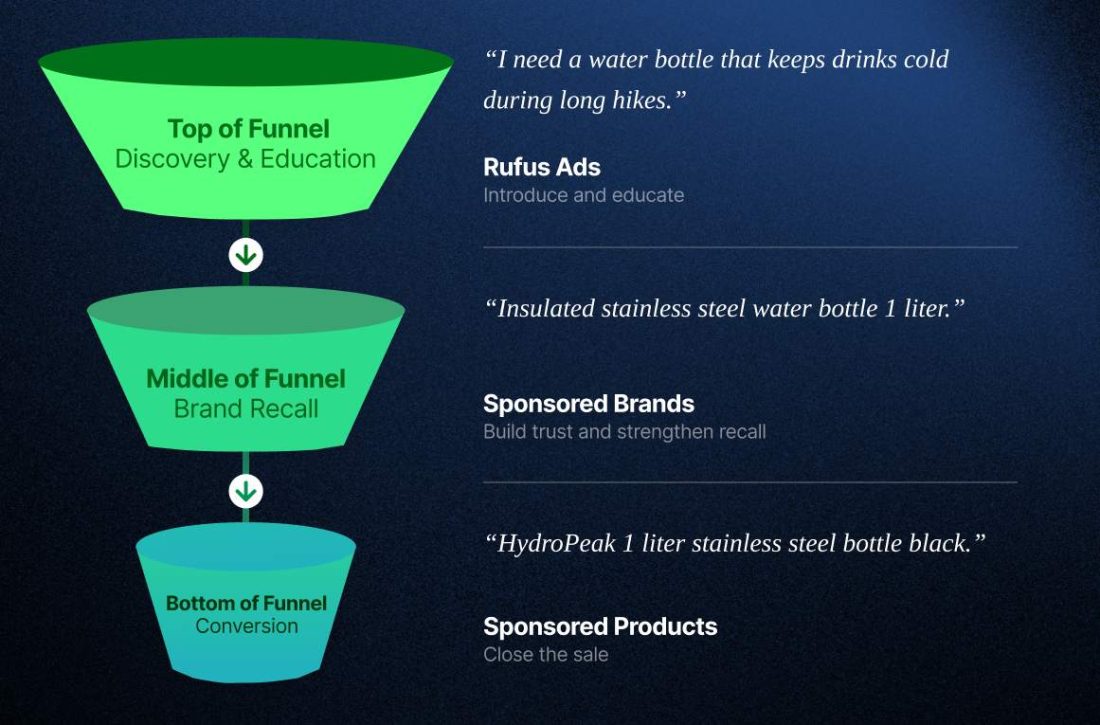
These formats are not competitors. They operate at different stages of buyers’ intent and perform best when aligned rather than isolated.
Run Ads on Amazon Rufus Wisely and What Sellers Are Still Wondering About?
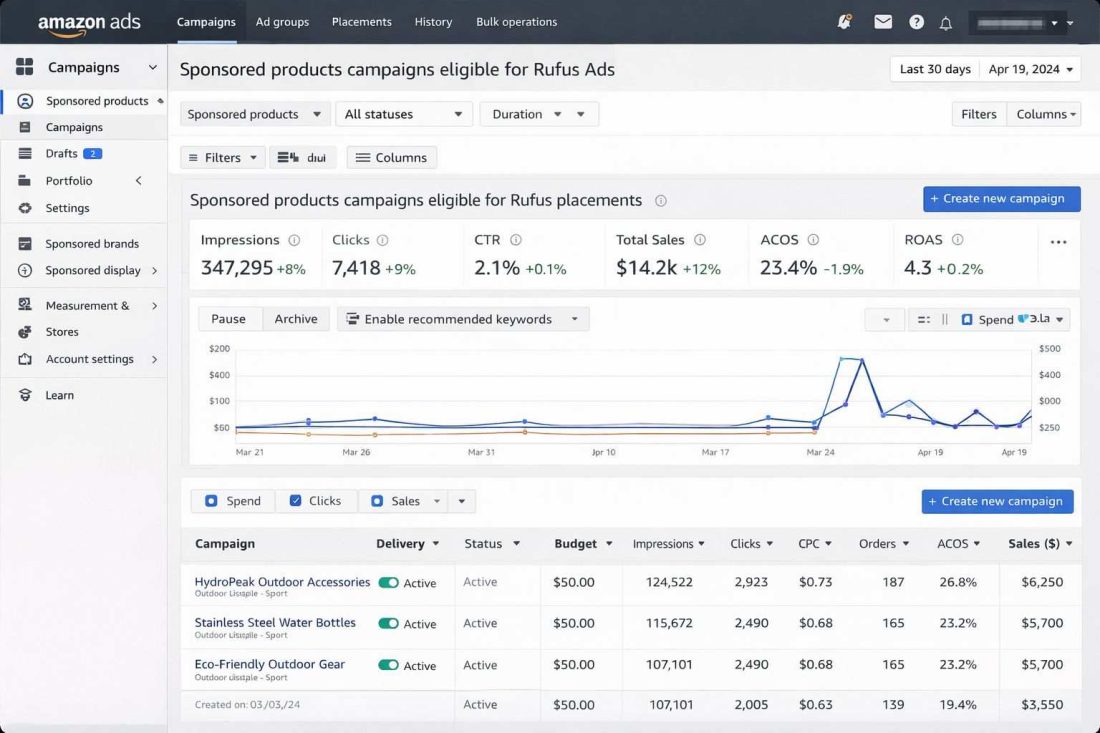
As Amazon Ad Rufus is still in beta, availability varies by account and region. In many cases, Rufus inventory is accessed through existing Sponsored Product campaign structures rather than a separate toggle.
A doable approach includes:
- Ensuring product eligibility
- Structuring campaigns around clear keyword clusters
- Aligning listings with conversational phrasing
- Monitoring placement performance
Since placement control may be limited, patience is the key. Small adjustments tend to outshine sudden restructuring.
What Sellers Are Still Unsure About With Amazon Rufus Ads
Whenever Amazon introduces a new surface, sellers find it very difficult to understand the smooth perks and visible pain points of the platform. Here is our curated guide to our readers’ most asked questions.
Sellers often ask:
- Will Amazon ads Rufus replace Sponsored Products?
- Do I need a Brand Registry?
- Is this worth testing right now?
- How much control do I really have?
But beneath those questions lies a bigger one. Are my listings even written for this shift? For years, sellers optimized for keyword density. Titles were written to rank, not to sound natural. A title like “Premium stainless steel kitchen utensil set, durable ergonomic cooking tool” is technically correct. Keyword-rich. Optimized.
But consider this for a moment. When was the last time you spoke like that?
When we talk to ChatGPT, we do not say: “Premium stainless steel kitchen utensil set, durable ergonomic cooking tool”.
We say: “I need kitchen tools that won’t bend when I’m cooking for my family.”
We speak in problems. We speak in context. Very much human-like. And any conversational AI, including Amazon Rufus, responds to that sort of language.
So, for the AI, “Durable kitchen tools that won’t bend while cooking for a large family,” answers the prompt clearly. Hence, it would recommend such products. Though the product is the same. The communication is different as it mirrors real buyer language.
Challenges With Amazon Ads Rufus and How Sellers Can Solve Them
Amazon Ads Rufus, being relatively new in the advertising world, is quite challenging to understand. Think of Rufus as a shopping consultant that listens to what the buyer is asking, evaluates options, and then recommends products that fit the situation, with ads appearing as sponsored suggestions inside those recommendations. Here is the set of questions that our sellers have on Amazon Rufus, and our answers and practical solutions to bag profit from Amazon Rufus Ads.
How do I know which queries Rufus might surface my product for?
It’s precisely because Rufus works on intent, guessing is risky. Sellers need to analyze real buyer phrasing patterns rather than relying only on high-volume keywords.
One of the biggest challenges sellers face with Rufus is understanding which shopper intents matter most. Traditional keyword volume doesn’t tell the full story anymore because Rufus operates on conversational language and semantic intent. Whether surfaced in search or through Rufus, aligning your content with how customers actually phrase their needs increases relevance, which drives sales.
A great example of solving this is the Windscreen Supply Co case.
In their original listings, the focus was on broad, high-volume search terms that worked well in a purely keyword-based world. But when we looked at real buyer language and search term clusters, we found that many relevant high-intent queries weren’t being captured in the listing. By analyzing actual search behavior and aligning the product copy with how real customers phrase their needs, Windscreen Supply Co was able to capture more relevant traffic and improve both visibility and performance even before increasing ad spend.
This issue resonates with a core point about Rufus: it’s not enough to guess what buyers might type. You need to understand how buyers actually ask questions and then align your listings to that intent.
By identifying the phrases and question structures that match with buyers in practice, sellers can better position their products for surfaces like Rufus, where natural language matters more than exact match volumes.
The lesson here is not to chase Rufus placement directly but to strengthen intent alignment. Once that is sorted, AI systems like Rufus are more likely to surface your product organically.
Rufus depends heavily on listing quality.
If your listing does not clearly communicate benefits and use cases, Rufus may struggle to align it with conversational queries. Rufus or not, when your listing clearly answers real buyer questions, conversions improve. Stronger conversion signals naturally promote organic ranking.
A good example of this shift can be seen in SellerApp’s work with Teeccino. The brand was already established, but its listings were not fully aligned with evolving search behavior and intent signals. After analyzing keyword patterns, refining content structure, and improving listing quality based on performance data, the brand experienced measurable improvements in visibility and conversions.
As conversational AI depends heavily on listing clarity and intent alignment, optimizing content is no longer just about inserting high-volume keywords.
Tools like SellerApp help sellers diagnose weak listing elements, strengthen content quality, and align messaging with how real customers phrase their needs. In an AI-driven discovery environment, listing quality becomes a strategic advantage rather than a cosmetic update.
The takeaway is simple. When your listing clearly communicates value and answers real buyer questions, performance improves across the board. Keep the fundamentals strong, and surfaces like Rufus are far more likely to recognize and reward that clarity.
It is hard to track what influences discovery.
Traditional PPC focuses heavily on CTR and ACOS. But conversational environments introduce discovery influence that may not always appear as last-click attribution. Even outside of Rufus placements, aligning, listings, keywords, and campaign data strengthens overall performance signals, which translates into higher visibility and profitability.
For example, in SellerApp’s work with Cardology, performance improvements did not come from aggressive bid increases alone. Instead, structured optimization across listings and campaign data helped clarify product positioning and align keywords with actual buyer intent.
As listing quality and targeting alignment improved, the brand saw measurable gains in visibility and engagement. What made this interesting was that the lift was not tied to a single click or campaign adjustment. It was the cumulative impact of better alignment across content, keywords, and advertising.
This highlights a broader challenge with Rufus and AI-driven discovery surfaces. Not every improvement shows up immediately in last-click metrics. Stronger content can influence relevance. Better keyword alignment can improve placement eligibility. Higher engagement can reinforce visibility signals over time. Discovery becomes layered, not linear.
The solution is to move beyond isolated metrics and adopt a unified view of performance. Instead of looking only at CTR or ACOS, sellers need visibility into search term behavior, listing quality gaps, and campaign-level trends together.
SellerApp helps bring those elements into one framework, allowing sellers to identify which optimizations are actually influencing discovery rather than guessing based on surface-level metrics.
Structured optimization benefits the entire ecosystem. When the basics are solid, discovery systems, whether search-driven or AI-driven, work in your favor.
Final Thoughts: Preparing for a More Conversational Amazon
Amazon Rufus Ads are not just another placement to test. They represent a subtle shift in how discovery works on the platform. For years, success on Amazon meant mastering keywords and bidding efficiently. That foundation still matters. But conversational AI introduces a new layer. It interprets questions, context, and intent. It evaluates listing clarity. It blends organic and paid visibility inside guided responses.
Meaning, sellers can no longer treat content, keywords, and advertising as separate tasks. The brands that will perform best are the ones that align their messaging with real buyer language, strengthen listing quality, and use data to understand how visibility is earned across the funnel.
Rufus introduces and educates. Sponsored Brands build familiarity. Sponsored Products close the sale. Together, they form a connected strategy. Improving listing quality will not magically guarantee rankings. Increasing bids will not automatically secure visibility.
But aligning intent, clarity, and performance data significantly improves the odds. Amazon is not abandoning keywords. It is expanding beyond them. And sellers who understand that shift early will be better positioned to adapt, compete, and grow in a marketplace that is becoming more conversational every day.
That being said, a wise shift to Rufus Amazon Ad demands strengthening the very foundation of your products. Ranging from listing, infographics, to reviews. Fixing the basics yet vitals through our Amazon PPC agency can help you accelerate your brand growth. Of course, even if you require a more comprehensive support you can always take advantage of our Amazon Full Service Management Services.
1. Will Amazon Rufus ads replace Sponsored Products?
Short answer: No. Amazon Rufus Ads do not replace Sponsored Products. They serve a different purpose. Sponsored Products are still the main way to capture high-intent, bottom-of-funnel demand. Ads on Rufus appear when shoppers are asking questions and comparing options, so they work earlier in the journey.
2. Do I need a Brand Registry to use Amazon Rufus Ads?
Not necessarily. Brand Registry helps unlock more features and control on Amazon, but Amazon Ads to Rufus eligibility is still rolling out. If you’re brand-registered, you may get access sooner and have more creative options, but it’s not strictly a requirement yet.
3. How much control do I really have with Amazon Rufus Ads?
Ads on Rufus currently offer less granular targeting than traditional Sponsored Products. Instead of targeting exact keywords, Amazon’s AI matches your product based on intent and relevance signals. That means you influence placement more through listing quality and intent alignment than micro-targeted bids.
4. Why did my traditionally optimized listing stop performing well with Amazon ads for Rufus?
Many sellers optimized listings for keyword density and hard-coded phrases that worked with old search logic. Conversational AI, like Amazon Rufus, prioritizes natural, human language. Listings that mirror how real customers ask questions tend to perform better. For example, “durable kitchen tools that won’t bend while cooking” aligns more with intent than a list of keyword fragments.
5. Can improving my listings increase my chances of showing up organically in Amazon ads to Rufus?
Yes. While improving listing quality does not guarantee organic placement, clearer and intent-aligned content significantly increases the likelihood of appearing in AI-driven recommendations. Amazon ads to Rufus match context, not just keywords, so better messaging improves relevance signals.
6. Which performance metrics matter most for Rufus Amazon Ads?
Traditional metrics like CTR and conversion rate are still useful, but they tell part of the story. Engagement signals, add-to-cart behavior, and how well your listing satisfies shopper intent are also important. Rufus Amazon ads are context-driven, so stronger alignment often shows up across multiple touchpoints, not just last-click.
7. How can sellers use Amazon Ads Rufus to optimize their listings? What is the actual workflow?
Rufus Amazon ads can be used as a practical intent-testing tool. Sellers can begin by asking Rufus the same type of questions real shoppers would ask, such as “ Which water bottle keeps drinks cold during long hikes?” The goal is to observe the language feature and the benefits of Amazon ads to Rufus emphasizes in its response. Then, sellers can compare that language with their own listings and update titles and bullet points to reflect natural problem-solving language. This strengthens contextual alignment, improving eligibility for AI-driven placements.
Read More:
Amazon Ads Single Keyword Campaigns (SKCs): How it Improve Amazon PPC Performance
9 Best Amazon AI Tools in 2026 (How U.S. Sellers Use AI to Scale Without Wasting Ad Spend)
How the Roku Amazon Ads Partnership is Revolutionizing TV Ads for Amazon Seller
The post Amazon Rufus Ads: What They Are, Who They Are For, and How Sellers Can Win. appeared first on SellerApp Blog.
from SellerApp Blog https://ift.tt/g50koxn
via IFTTT
Add a review