
Grow Sales With Amazon SEM by Understanding Algorithms, Sales Signal and Conversion
Descriptions
Running ads on Amazon would be way easier if you knew how exactly how Amazon SEM works. The whole Amazon Search Engine Marketing (SEM) is an ecosystem designed solely for e-sellers trying to make sales from their products that addresses the pain points of their consumers.
Amazon SEM is not just designed to save your business, but to reward products that already give a good shopping experience on Amazon. That’s why some ads scale so well while the rest burn budgets heartlessly.
Amazon SEM is often misunderstood as a savior. This guide is an attempt to help you understand how Amazon Search Marketing works so that you grow with Amazon, not quarrel with it.
Quick Guide :
1.Understanding Amazon SEM and Its Benefits
2.What is Amazon SEM Marketing Service?
3.How Amazon SEM Advertising Fits Into the Amazon Selling Platform?
4.How and why Amazon search engine marketing SEM is different from Google SEM
5.How These Ad Types Work Together
6.How do customers discover products on Amazon?
7.What is Automatic & Manual Targeting in Amazon SEM PPC?
8.Key Metrics that Count in Amazon SEM Marketing Services
9.How do New-to-Brand (NTB) develop long-term Amazon SEM PPC growth?
10.What does NTB actually tell Amazon for you?
11.Final Thoughts: Make a budget-friendly pact with Amazon SEM Marketing Services
Understanding Amazon SEM and Its Benefits
Amazon Search Engine Marketing (SEM) works more like a salesperson in a retail store. The one who steps in only after the customer has already shown interest.
Likely, the shopper is already browsing. They are comparing options. They are very close to making a decision.
Amazon search engine marketing SEM doesn’t interrupt it’s shopper’s journey. But Amazon supports it through ads. Ads are placed where customers are already searching with intent, helping them find the most relevant product and complete the intended purchase.
This is why Amazon SEM services are basically different from awareness-centric advertising, as they operate closest to the point of sale.
When used correctly, Amazon SEM marketing services don’t automatically create demand out of thin air, but they can help its sellers by reducing the friction at the moment of purchase.
What is Amazon SEM Marketing Service?
Amazon Search Engine Marketing (SEM) is Amazon’s internal advertising system that allows products to show up across search results, product pages, and discovery pages, but only when Amazon sees consistent signals that the product is more likely to convert when shown to shoppers.
This “trust” is built through relevance to the search, competitive bidding, and early performance signals such as click-through and conversion behavior.
The algorithm doesn’t care how aesthetic your ad looks, how much effort went into launching it. What it evaluates is whether showing this product creates a good shopping outcome.
Conversion plays a vital role in that evaluation, but it’s not the only output. Amazon search engine marketing SEM looks more at relevance, bidding competitiveness, and early performance to decide if an ad deserves continued visibility.
Let’s say you are selling an organic shampoo. You increase bids and start getting clicks, but shoppers don’t convert. Even with competitive bids, Amazon begins to reduce impressions because the ad is failing to meet its core objective of matching shoppers with products they are most likely to buy.
From Amazon’s point of view, a good product should make the shoppers’ shopping experience better.
How Amazon SEM Advertising Fits Into the Amazon Selling Platform?
Amazon SEM advertising sits at the point where the buyer’s shopping intent already exists. While Amazon supports demand creation through channels like DSP and off-Amazon media, its search advertising system is basically designed to guide shoppers complete purchases that they are already planning to.
This is why Amazon SEM PPC services honour advertisers who focus on relevance, conversion, and the whole shopping experience. Not just visibility. A product that consistently gets the shoppers to click, engage, and ultimately buy earns more exposure, even at a similar bid level to the other products.
In the Amazon search engine marketing SEM platform, advertising is not a shortcut to growth. It amplifies a product’s performance that is already aligned with customer intent and affects those that create friction in the buying journey.
How and why Amazon search engine marketing SEM is different from Google SEM
The functionality of Google and Amazon SEM PPC services is entirely different because the intent behind each platform is different. Google is built to answer questions, compare choices, and guide users to research.
Amazon exists to bridge the distance between intent and purchase. Its ad system is not optimised for exploration. Its focus is more on transaction efficiency.
If your product confidently moves a shopper from search to checkout, you win!
Google SEM rewards:
- Clicks
- Relevance to a query
- Landing page experience
Amazon SEM Services rewards:
- Sales
- Conversion probability
- Post-click performance
Amazon search engine marketing SEM doesn’t care about your customer traffic unless it turns into actual customers who click, shop, and have an effortless e-shopping experience.
The simple difference is that on Google, a click is a success.
While on Amazon, a click that doesn’t convert is closer to a loss.
Core Amazon SEM PPC services Advertising Types, and the Right Way to Use Them
Amazon offers multiple advertising formats that are designed to serve different purposes. Each ad type supports a different stage of the customer journey, starting from active buying to passive discovery.
Understanding when to use each ad type is as important as managing to set them up.
Sponsored Products – The Sales Engine
Sponsored Products are the most commonly used yet generally pretty misunderstood Amazon ad type. These ads appear directly within search results and on product detail pages, making them great for capturing high-intent traffic.
When the seller’s intention is
- To drive immediate sales
- To rank for high-intent keywords
- To support organic visibility
- To test keyword and product performance
Sponsored products become the hero to yield good results.
For example, a seller launches a stainless-steel water bottle. When customers search “steel water bottle 1 litre,” Sponsored Product ads appear directly among the organic listings. Now that the shopper already knows what they want, Sponsored Products just shorten the decision-making process and convert quickly.
Please note that Sponsored Products work well for you only when your listing is properly optimised, competitively priced, and capable of converting clicks into purchases.
Sponsored Brands: Building Brand Recall and Authority
Sponsored Brands allow you to showcase your brand logo, custom headline, and multiple products at the top of search results.
Sponsored Brands shine when you want to
- Build brand recognition
- Cross-promote multiple products
- Defend branded keywords
- Introduce customers to your product range
Think of a skincare brand selling cleansers, toners, and moisturizers that uses Sponsored Brands for searches like “herbal skincare routine.” Instead of promoting a single product, the ad introduces the brand as a one-stop solution, encouraging customers to explore multiple products under that particular brand.
Sponsored Brands are particularly effective once you have more than one strong product and want to guide shoppers into your platform.
Sponsored Display: Re-Engagement and Defensive Targeting
Sponsored Display ads reach shoppers both on and off Amazon, based on browsing behaviour rather than just search terms. These ads are powerful for retargeting and to outshine competitors.
Sponsored Display can be used best.
- To retarget viewers who didn’t purchase
- To appear on competitor product pages
- To protect your own product detail pages
- To re-engage high-intent shoppers
For example, a customer views a coffee maker but doesn’t buy. Later, while browsing another product, they see a Sponsored Display ad for the same coffee maker. This reminder gently nudges them back into buying, more often at a lower cost than acquiring a brand-new customer.
Amazon DSP: Scaling Beyond Search (Including Streaming TV)
Amazon DSP allows advertisers to reach audiences both on and off Amazon using advanced audience targeting. Unlike Sponsored Ads, DSP focuses on upper and mid-funnel growth.
Amazon DSP can be utilised to:
- Scale brand awareness
- Retarget past purchasers
- Bring external traffic into Amazon
- Support long-term brand growth
For example, consider a premium nutrition brand that runs streaming TV ads through Amazon DSP, targeting fitness and wellness audiences. Viewers don’t buy immediately, but when they later search for supplements on Amazon, the brand feels “Known”, increasing the likelihood of conversion.
DSP works well when combined with Sponsored Products and Sponsored Brands, creating a full-funnel strategy from awareness to purchase.
How These Ad Types Work Together
Let’s see them as a group of creatives. They work best when each one is used at the right moment in the customer journey.
Each of them is unique and serves different purposes as follows:
- Sponsored Product is useful when the shopper already knows what they want. These ads shorten the path to checkout and are the most effective for high-intent searches and ranking-critical keywords.
- Sponsored Brand works higher up the funnel. They help shoppers identify your brand during search, especially when they’re still comparing options or building a brand shortlist.
- Sponsored Display supports shoppers who showed interest but didn’t commit to purchase. It gently retargets indecisive shoppers, defends your product page and keeps your competitors from intercepting high-intent traffic.
- Amazon DSP expands band reach beyond active search. It introduces your brand to a new audience and softly reinforces brand recall. Later, when shoppers search on Amazon, your brand already feels familiar.
Individually, these ad types drive visibility, while together they create effective continuity from the first impression to final purchase.
Role of intent, relevance, and performance in Amazon Search Marketing
Amazon search engine marketing SEM works on a simple but ruthless hierarchy:
- Intent – How Close is the shopper to making a purchase?
For example, A customer searches for “protein powder for women”, and the other one asks, “What is whey protein?”
The first search signals clear purchase intent. The customer is way closer to making a purchase. The second is more informational.
Amazon prioritises displaying ads for high-intent searches, as they have more chances to convert to sales.
2.Relevance – Does your product rightly match the search?
Let’s assume a shopper searches for a “herbal anti-dandruff shampoo,” and you are selling a general shampoo with herbal ingredients buried in your bullet points.
Amazon may still test your ads briefly, specifically in sponsored products, to assess relevance across the listing and early performance signals.
How relevance is evaluated can differ by ad type, but the core principle still remains the same. Clearer matches reduce shoppers’ confusion and convert better.
3.Performance – Do customers actually purchase after clicking?
Imagine two similar products receiving clicks for the same keyword. One converts consistently due to strong reviews, competitive pricing, and clear images. The other doesn’t.
If this pattern persists over time, Amazon will shift impressions towards the performing product, even if the bidding is the same.
These steps are non-negotiable. Meaning, you technically can’t “optimise” your way out of poor performance. You can only earn trust by converting traffic to sales.
How do customers discover products on Amazon?
Most discovery happens in three places:
- Search results
- Product detail pages
- Category and recommendation placements
Amazon SEM PPC will not force discovery. It enhances what is already working.
If your customers click, stay, and buy, Amazon takes your side.
If they hesitate or close the tab, Amazon skips you.
Why is visibility in Amazon SEM search engine advertising earned but not permanent?
This is the “grace” part. Amazon does give products chances. What it doesn’t promise is loyalty.
Every impression is a test that should answer Amazon’s “Will this product help this customer buy faster?”
If the answer is mostly yes, visibility grows.
If it is a no repetedly, then visibility fades, despite a high budget.
That’s why Amazon SEM PPC services’ success looks slow at first and unstoppable once the momentum hits.
What is Automatic & Manual Targeting in Amazon SEM PPC?
Automatic and manual targeting serve different purposes within Amazon SEM, but are a part of the same optimisation workflow.
While one helps Amazon learn about your product, the other helps you monetise on what Amazon has already learned.
Look at real situations to understand the obvious differences between Automatic and Manual targeting.
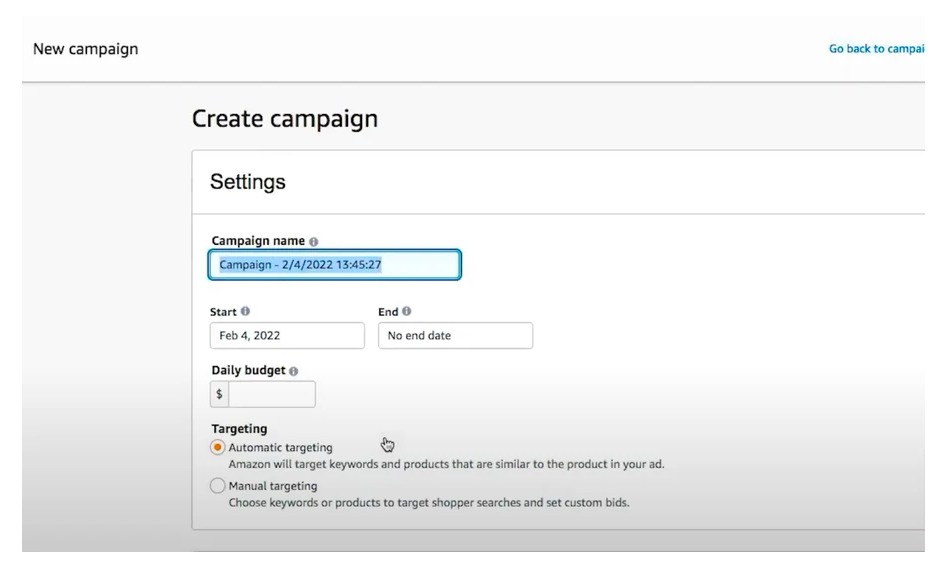
Role of Automatic Targeting in Amazon SEM Marketing Services
Automatic targeting allows Amazon to decide where your ads appear based on your listing content, category placement, and early customer behaviour.
For example, you launch a new herbal face wash. You know it’s good for acne-prone skin, but customers might search in dozens of ways like “neem face wash,” “face wash for oily skin,” “anti-acne cleanser,” and more. Instead of playing the guessing game with your consumers, you run an automatic campaign.
Amazon tests your product across multiple search terms and placements. Within a few weeks, you notice that most sales are coming from searches related to “oily skin” rather than “acne.” That insight is the light as it comes without manual assumptions.
Automatic targeting guides you by telling you where exactly Amazon naturally see demand for this product.
When Automatic Targeting Works the Best
Automatic targeting works best when you are still learning how customers perceive your product, not when trying to persuade them on how you wanna be perceived.
For example, a seller launches a protein bar marketed for gym-goers. Automatic campaigns reveal that most purchases are coming from searches like “healthy office snacks” instead of “pre-workout snack.”
This tells the seller that the product’s strongest appeal lies outside the gym context. Without automatic targeting, this discovery would’ve been completely missed.
One practical way to make use of automatic targeting is to farm high-intent search terms that don’t show up during manual keyword searches.
For example, while keyword toolsmight suggest terms like “protein bar” or “pre-workout snack”, automatic campaigns often surface unexpected yet commercially strong queries such as “healthy office snacks” or “low sugar snack for work”
Such terms usually carry a strong buying intent, convert pretty well organically and also reflect how real customers describe the product.
Now that automatic targeting has done its job of discovering high-intent search terms, manual targeting takes over for efficiency and scaling.
Role of Manual Targeting in Amazon Search Engine Marketing Service
Manual targeting lets you take full control once patterns emerge. Instead of letting Amazon spread your budget broadly, you concentrate your spending on what has already proven to convert.
For example, a seller from an automatic campaign will find that “face wash for oily skin” generates consistent sales with a strong conversion rate. As a next step, he/she will move this term into a manual campaign with exact match and assign a higher bid.
Here, instead of testing, you’re actually protecting and scaling a proven sales driver.
Manual targeting helps you understand how to get more sales from what already works.
When Manual Targeting Works Better?
Manual targeting works the best when efficiency and predictability count more than mere exploration.
Let’s consider a brand selling wireless earbuds that notices that competitor product pages convert extremely well when hit on via product targeting. They then create a manual product-targeting campaign that is primarily aimed at those specific ASINs with controlled bids.
Ain’t the result fruitful? Lower wasted spend, higher conversion rates, and stable daily sales are something that just automatic targeting could never guarantee.
How to let automatic and manual targeting coexist?
The most effective Amazon SEM PPC strategies let automatic and manual targeting run in parallel, not as a loner.
Meaning, you can keep automatic campaigns active at a lower budget to continue locating new search terms. Meanwhile, you also funnel converting terms into manual campaigns for tighter control.
This balance ensures you’re always learning without spending much on inefficiency.
Key Metrics that Count in Amazon SEM Marketing Services
Amazon gives you a dashboard full of numbers. Some look impressive. Some looks scary. While some also decide whether your ads win or fail. There are several key metrics that play a crucial role in helping you track the status of your ads. IfAmazon search engine marketing SEM had a report card, these are the subjects that actually matter.
- Conversion Rate (CVR)
Your product’s conversion rate answers Amazon’s most important questions while also providing you with a clear insight into “when we show this product, do people actually buy it?”
In short, it signals Amazon and the seller by giving a clear picture of how many sales you made through the ads.
Sellers can have great creatives, aggressive bids and tons of clicks. But if customers don’t convert, Amazon starts pulling back visibility.
For example,
Imagine you’re selling a herbal shampoo.
You get 100 clicks.
But you have only 3 sales.
That’s a 3% conversion rate.
This primarily signals one thing. “People looked. The hesitated. Something didn’t feel right”
Low CVR usually signals a pricing mismatch, weak reviews, a confusing listing, or even a keyword intent mismatch. Ads can’t fix those, but they do throw a spotlight on these issues.
- Click Through Rate (CTR)
CTR tells you if your ad is interesting enough to earn a click. Consider this as the window shopping metric.
If your CTR is low, Amazon assumes the ad to be irrelevant or that the listing didn’t match the search intent.
For example, in a situation where two sellers( A & B) bid on “steel water bottle 1 litre”
If Seller A’s product has a clear title, a clean image, and the right size shown. He would get a higher CTR.
While Seller B’s product has a vague title, with lifestyle images hiding the product, the click-through rate will obviously decrease because it cannot pull traffic.
Amazon clearly notices this difference. But here’s the catch.
“High CTR with low conversion rate is not a win.”
Because it is like inviting people to your store while watching them walk right back out. Minutes of attention without conversion don’t gain anyone anything, right?
- ACOS: The Hygiene Metrics
ACOS tells you how much ad spend it takes to generate ad-attributed sales. It is very useful and necessary but it’s not the only hero. It is a hygiene metric that sellers should track to run clean, profitable ads.
For example, you spend $1000 on ads and make $4000 in ad-attributed sales.
Your ACOS is 25%.
This signals that your ads aren’t wildly inefficient. It’s a good sign, initially.
ACOS answers your “Are my ads wasting money?” confusion.
But ACOS individually can’t tell you if your:
- Organic sales increased
- Ranking improved
- Brand searches grew
In simple words, it doesn’t answer “Are my ads helping my business grow?” and that’s the exact place where sellers get stuck.
- TACoS: A Growth Reality Check.
TACoS stands for Total Advertising Cost of Sales. It looks at total ad spend vs your total revenue. Meaning, it addresses your “After running ads, did my overall sales improve or did nothing really change?” query.
For example, let’s say
You spend $10,000 on ads.
Ads directly generate $30,000 in sales.
Meanwhile, your organic sales (sales without clicking ads) are $70,000
So, your total sales for the month are $30,000 (Ad sales)+ $70,000 (organic sales) = $100,000
This $100,000 is your total revenue.
Basically, TACoS is calculated like this.
TACoS = Ad spend divided by total sales.
So, $10,000 divided by $100,000 = 10% TACoS.
What does this actually mean?
ACOS says: “Ads needed 33% to pay for themselves”
TACoS signals: “Your Ads only took 10% of your entire business revenue”
Do you see the difference?
TACoS tells you that your ads didn’t just sell products but also helped with organic sales growth and aided ranking and visibility.
This highlights how “Ads did more than just run. They contributed.”
Why TACoS Aligns Better with Amazon’s Algorithm?
Amazon evaluates a product based on customer acceptance. If your ads help you increase sales, maintain constant velocity and improve organic ranking, it’s a green flag for you from Amazon.
That’s why ads with a decent TACoS often keep getting impressions while super low ACOS campaigns that don’t move sales gradually stall.
- Sales Velocity
It’s safe to call it Amazon search engine marketing SEM’s heart beat monitor, as this answers “is this product selling consistently over time?”
Amazon doens’t call about a sales spike or a blue moon lucky day. What matters is consistency.
Example:
- Product A sells 5 units every day
- Product B sells 50 units once a week.
Amazon would trust product A more. Because predictable sales mean a reliable shopping experience.
This is exactly why:
- Cutting ads intensively can hurt your ranking
- Pausing the campaign right after ranking still backfires.
- Once-in-a-while spikes don’t impress the algorithm.
- Making sales velocity the result of everything (CVR, CTR, pricing, reviews and sensible ad spend) working in your favour.
SEO+SEM: An Ideal Alliance
On Amazon, SEO & SEM are often treated as separate strategies. One is organic, and the other is ads. But, in reality, they are very interconnected. Separating them usually slows growth instead of accelerating it.
Amazon SEO is driven by performance signals, such as how often your product gets clicked, how frequently it converts and how consistently it sells. SEM feeds on these signals.
When ads drive verified traffic that converts, they empower the very metrics Amazon’s organic ranking system depends on. This is how ads support rank momentum even when customers don’t click the sponsored badge.
Assume a product ranks on page two organically for its high-intent keyword. Sponsored Product ads push it into gradual visibility, generating sales growth. Over time, Amazon starts ranking the product higher organically, not just because of ads, but also because ads accelerated proof of customer demand.
This relationship works both ways. Strong SEO with clear titles, relevant keywords, competitive pricing, and solid reviews improves SEM effectively.
Good listings convert more clicks, which in turn lowers wasted ad spend and improves performance signals. Weak SEO, on the other hand, turns SEM into an expensive trial.
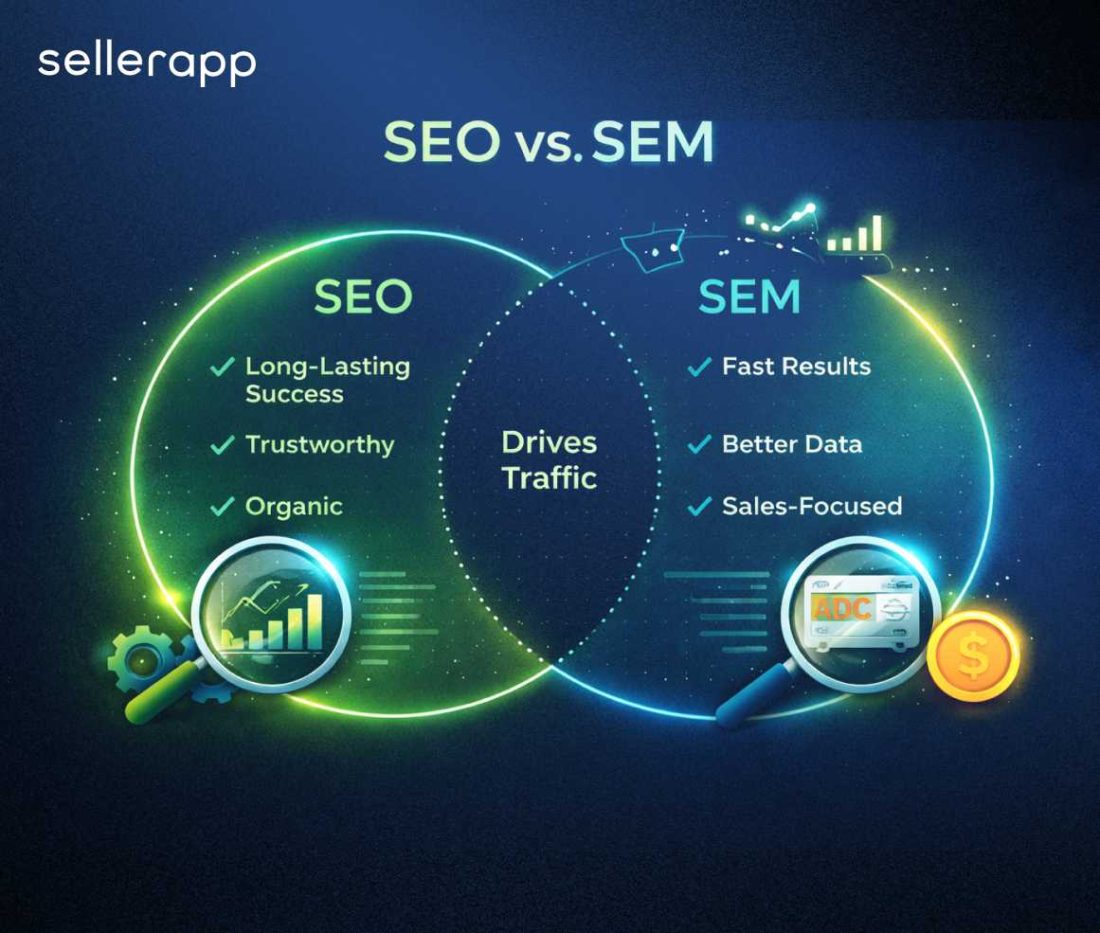
Know the alliance is working through TACoS.
On Amazon, SEO and SEM work together only when ads lift total sales, not just paid ones. That growth shows up in TACoS. When sponsored ads bring relevant traffic and strong listing converts it, organic sales begin to gradually increase.
Gradually, this causes TACoS to improve even if ad spend stays the same.
For example, if your ad spend is $6000
If the first month’s total sale is $30000, your TACoS is 20%
And the third month’s total sale is $45000, your TACoS is 13%
Nothing about the bits has changed. It is just that SEO absorbed the demand that SEM has created.
That’s the alliance successfully functioning for you.
How do New-to-Brand (NTB) develop long-term Amazon SEM PPC growth?
Most Amazon SEM advertising conversations stress short-term sales, but NBT makes you look just past that and asks a much bigger question. “Are your ads bringing new customers into your brands?”
New-to-Brand customers are the shoppers who are shopping your products from your brand for the first time in the past 12 months. These are the fresh customers who haven’t interacted with your brand before.
This is exactly why they matter, because repeat customers sustain revenue, but it’s the new customers that create growth.
What does NTB actually tell Amazon for you?
When Amazon sees a consistent inflow of NTB purchases, it reads as “This brand isn’t just selling. It’s being discover”
This read signals Amazon that
- The brand is discoverable.
- Ads are expanding their reach beyond existing customers.
- First-time shoppers believe the listing enough to convert.
And Amazon adores brands that help shoppers discover something new, provided it doesn’t disappoint the shopper’s experience.
For example, let’s say you run a Sponsored Brand campaign.
Your ad spend is $5000
Total sales from ads is $25000
NBT sales become $15000
That means 60% of your ad-based sales come from the first time buyers.
But here is the important part.
Even if your ACOS isn’t great, Amazon sees new customer acquisition, brand discovery working, and your potential for repeat purchases.
From a long-term perspective, this is not pointless spending but a brand-building inside a demand-ready marketplace.
NBT+Amazon SEM for a sustainable growth strategy
Amazon SEM search engine isn’t only about converting existing demand but also about earning the privilege to be displayed to new shoppers.
A campaign with a strong NTB performance shows that the ads are not just targeting the same audience, but the brand resonates with new buyers too, and the shopping experience works for first-timers.
This is exactly why NTB is closely associated with Sponsored Brands, Sponsored Display and Amazon DSP, as these formats are designed not just to see but also to introduce in a loop.
Common Expensive Amazon SEM advertising mistakes that sellers make
Most of the Amazon SEM advertising malfunctions don’t happen because the seller didn’t know how to run ads. It happens due to a minor miscalculation. Sellers don’t understand what Amazon is actually rewarding as much as they understand the theory parts of metrics. These mistakes are super common and expensive.
Ads can’t conceal weak listings.
Running solid Amazon ads on an under-optimised listing is like running a 50% sale on a product that is out of stock. You do attract a crowd, but what is the point?
If your images, pricing, reviews or bullet points don’t convert, ads only accelerate losses.
Chasing Visibility Instead of Conversion
Many sellers obsess over impressions and clicks. High visibility feels productive, but without conversion, it sends negative signals. If your click doesn’t convert, it isn’t a mishap but feedback to the algorithm.
If you are constantly attracting shoppers, guiding them to nowhere, it weakens both paid and organic performance.
Scaling Budget Even Before Earning Trust
Increasing spend even before winning keywords or ASIN targets leads to wasted budget. Amazon gives a tentative chance to prove themselves.
Scale might be the main course for sellers, but what gives you growth is focusing on the right listings. So, why not start with appetisers?
Letting Automatic Campaigns Run Unchecked
Automatic targeting is very helpful when you want your brand to be discovered by the shoppers, but you can’t let it run without supervising it.
Without making use of the converted search terms into manual campaign, sellers end up paying in a loop for the same data.
Optimising only to be validated with low ACOS
Yes. Low ACOS is impressive on papers. But we all know it doesn’t always mean growth. Cutting down on spend drastically can kill momentum, slow sales velocity and bag organic ranking.
Efficiency still counts, but would you choose it over sales?
As you know, the above-mentioned mistakes can’t be labelled careless. They mostly happen because Amazon data is slow to interpret and devious when you handle it all by yourself.
Wondering how to accelerate your brand growth? Maybe it’s high time you unlock better sales with our Amazon listing optimisation service.
Final Thoughts: Make a budget-friendly pact with Amazon SEM Marketing Services
Amazon SEM advertising works great when you partner it with genuinely reliable listings, bullet points, keywords, reviews, etc. This platform is not a genie, make a wish! At least for the sellers. In contrast, Amazon rewards products that deliver what the customers want, convert consistently and make shopping feel fun. And guess what? You are the genie asking your buyers to make a wish.
Does managing Amazon SEM advertising feel like juggling visibility, spend, and growth all at once? That is because it is. Keeping TACoS low while visibility and total sales grow demands more than bid tweaks. It requires alignment between your listings, targeting, budgets and long-term goals.
This is exactly where Amazon PPC Agency comes in. We help sellers focus less on running behind short-term efficiency metrics and more on building accounts where ads genuinely contribute to the overall growth of your business.
Amazon SEM advertising becomes more predictable, less expensive, yet far more scalable when you team up with Amazon’s algorithm, and not outsmart it by burning your budget.
FAQs
Does Amazon’s SEM marketing service really help with organic ranking?
Yes, but not in a direct or guaranteed way. Amazon SEM digital marketing can support organic ranking when they drive meaningful sales and conversions, because those sales contribute to performance signals like sales velocity.
When ad traffic moves shoppers from browsing to buying, organic visibility often improves over time.
If ads only generate clicks without conversions, they do not help organic ranking and simply become an expensive way to buy traffic.
Why did my Amazon SEM advertising suddenly stop getting impressions?
This usually happens when Amazon reallocates impressions due to declining ad performance.
Low conversion rates, rising CPC without corresponding sales, or increased competition can all reduce how often your ads are shown.
From Amazon’s perspective, this is a signal that the ad is no longer delivering strong shopping outcomes, so visibility is shifted toward better-performing products.
Should I pause Amazon SEM advertising once I start ranking organically?
Not immediately. Ads play an important role in defending organic rankings by maintaining sales velocity and protecting your listing from competitors who may target your keywords or product pages.
Pausing ads too quickly after achieving organic rank can reduce momentum and maycause rankings to drop rather than stabilise.
Which is better, automatic targeting or manual targeting?
Neither is better on its own. Automatic targeting works well for discovery and learning how shoppers find and interact with your product.
Manual targeting is more effective once patterns are clear, as it allows greater control and scaling of proven keywords and placements.
Amazon SEM digital marketing works best when both are used together as part of the same optimisation process.
What is a good ACOS on Amazon?
There is no single good ACOS that applies to every seller. It depends on your margins and your business goal at that stage.
A higher ACOS can be acceptable during product launches or ranking efforts, while a lower ACOS is usually preferred during stable growth phases.
What matters most is whether your ad spend is contributing to sustainable sales and overall business performance, not just efficiency.
The post Grow Sales With Amazon SEM by Understanding Algorithms, Sales Signal and Conversion appeared first on SellerApp Blog.
from SellerApp Blog https://ift.tt/ZyJeIzp
via IFTTT
Add a review