
Amazon DSP Targeting Tactics to Recover Lost Conversions and Scale What Works
Descriptions
Amazon DSP targeting lets brands reach high-intent audiences across Amazon and the open web to drive measurable profit.
It is not a plug-and-play channel. Without structured targeting and sequencing, it can quickly waste budget.
This guide breaks down how Amazon DSP targeting actually works, which options matter, and how to use them to build a profitable full-funnel system.
Quick Gudie:
- What is Amazon DSP, and why does it matter?
- How Targeting Differs Between Amazon DSP and Sponsored Ads
- Amazon DSP Targeting Options With Real Use Cases
- How to Access Amazon DSP Without Wasting Budget
- Amazon DSP Ad Types and Where They Appear
- Amazon DSP Retargeting Explained (5 Core Subtypes)
- The Amazon DSP Attribution Problem (And Why ROAS Lies)
- Last-Touch Attribution Bias
- 7-Day vs 14-Day Attribution Window Gap
- How Double Counting Inflates Performance
- How to Fix Amazon DSP Attribution Issues
- Key Metrics That Actually Matter in Amazon DSP
- When Sponsored Ads Will Outperform Amazon DSP Campaign Targeting
- Final Takeaway: When Amazon DSP Targeting Actually Makes Sense
What is Amazon DSP, and why does it matter?
Amazon DSP, or Demand Side Platform, is a programmatic advertising tool that lets you buy ad placements across Amazon-owned properties and external websites.
But the real difference is in how targeting works.
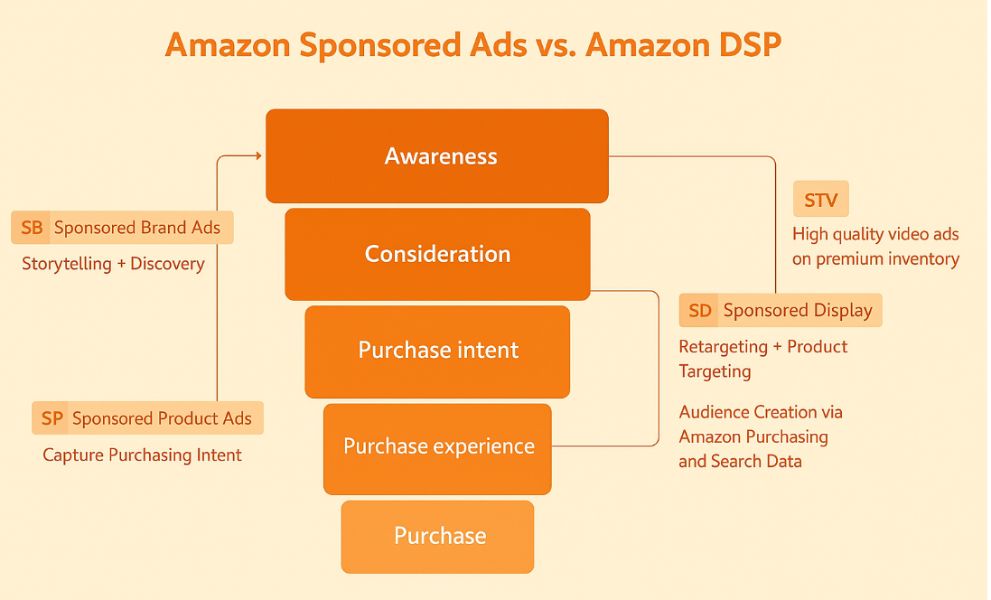
Sponsored Ads rely on keywords. You reach users when they search.
Amazon DSP targets audiences based on actual behavior, what they browse, what they buy, and how often they engage with a category.
That means you are not limited to moments of search. You can reach users before they search, while they are considering options, and after they leave without buying.
With Sponsored Ads, growth is tied to search volume and keyword expansion.
With DSP, growth comes from identifying and expanding high-value audience segments.
It also lets you act on signals that Sponsored Ads cannot fully capture, like repeat product views, competitor purchases, or category-level intent over time.
The result is not just more reach, but better control over who you reach and when.
That is what makes Amazon DSP a scaling channel, not just a demand capture tool.

How Targeting Differs Between Amazon DSP and Sponsored Ads
The difference between Sponsored Ads and Amazon DSP comes down to how targeting is defined and how much control you have over it.
Sponsored Ads targeting is query-driven. You are limited to the keywords users type in, which means your reach is constrained by active search behavior. Even with audience signals layered in, targeting still depends on someone entering the auction through a search.
Amazon DSP removes that limitation. Targeting is audience first, built on actual shopping behavior over time. You can reach users based on what they have viewed, purchased, or shown repeated interest in, regardless of whether they are searching right now.
This has two major implications for the targeting strategy.
First, you can prioritize users based on value, not just intent in the moment. For example, you can isolate high-frequency buyers, competitor customers, or users with multiple product views and treat them differently.
Second, you are not tied to the keyword scale. With Sponsored Ads, growth depends on expanding keyword coverage or increasing bids. With DSP, growth comes from expanding or refining audience pools.
Even the pricing model reinforces this difference. Since DSP operates on impressions, targeting quality becomes the main driver of efficiency. Poor targeting increases wasted impressions. Strong targeting improves both reach and downstream performance.
Inventory also plays a role, but only in how it supports targeting. Sponsored Ads are limited to search placements, so targeting is tied to that environment. DSP extends targeting across Amazon and the open web, which allows you to reach the same audience at multiple stages, not just when they search.
Amazon DSP Targeting Options With Real Use Cases
Amazon DSP targeting options are where most of the platform’s value comes from. But not all audiences behave the same way.
Each targeting type serves a different purpose in the funnel. Amazon DSP behavioral targeting is usually the first layer most brands activate, but mixing targeting types without a clear role leads to wasted impressions and weak performance.
Amazon DSP Behavioral Targeting: Actions Taken in the Last 30 Days
Amazon DSP behavioral targeting reaches shoppers based on actions taken in the last 30 days, browsing a category, clicking a listing, or watching a product video.
It is primarily a top-of-funnel awareness tool.
The smarter use case is layering repeat visitor behavior to push it into mid-funnel territory.
Someone who has visited your category three times in two weeks is signaling far stronger intent than a single browse, and that distinction changes how you message them.
How to Access Amazon DSP Without Wasting Budget
Getting access to Amazon DSP is not as simple as turning on another campaign type.
There are clear barriers to entry. Most brands need a minimum budget to get started, and DSP typically makes sense only after you have already scaled Sponsored Ads. That usually means you have strong conversion rates, high share of voice, and limited room to grow through search alone.
There are multiple ways to access DSP, and each comes with trade-offs in control, cost, and transparency. Choosing the wrong setup can limit how precisely you target audiences and how much visibility you have into performance.
That is why understanding how Amazon DSP targeting is actually executed behind the scenes matters before you commit budget.
You’re not just choosing a setup. You’re deciding how your targeting will actually be built, executed, and scaled.
That decision directly impacts how efficiently your budget translates into performance.
Self-Service vs Managed Service: What the 50K Minimum Really Gets You
Self-service means running Amazon DSP in-house. Your team owns targeting, setup, optimization, and reporting.
Managed service means an agency or Amazon team runs it for you.
At ~$50K/month, the difference is in execution.
In-house, most of that budget goes to media. You get control, but need strong internal expertise to build audiences, optimize bids, and drive efficiency.
With managed service, part of that budget goes into execution. You get structured audience strategies, ongoing optimization, and creative support, but less control depending on the partner.
$50K in DSP is not just media.
It is either buying control with capability or execution with trade-offs.
What to Check Before You Sign with an Agency?
Working with a DSP agency means giving up control over targeting, so visibility and ownership matter.
Start with Amazon Advanced Partner status. It signals proven experience and deeper platform access.
Next, confirm data ownership. You should retain access to your audiences, not lose them if you switch partners.
Transparency is critical. You need clear visibility into how audiences are built, how budgets are allocated, and how performance is measured.
Also look for technical depth. Few agencies have access to Amazon’s SP API, which enables better data integration and more advanced optimization.
SellerApp meets all of these criteria, with Advanced Partner status, SP API access, and a certified DSP team.
If you are evaluating DSP partners, we are worth a conversation to Grow Your Brand With Advanced Programmatic Advertising!
Amazon DSP Ad Types and Where They Appear
Ad types are not just a format decision. They shape how effectively your targeting and sequencing actually work.
Targeting and sequencing become more efficient when you match the right ad type to the right objective.
Each ad type plays a specific role across the funnel, from building awareness to reinforcing consideration to driving conversions.
If you do not understand how these formats function, you end up overusing one type and limiting performance.
Strong DSP execution comes from aligning ad types with audience intent, not treating them as interchangeable placements.
Display Ads
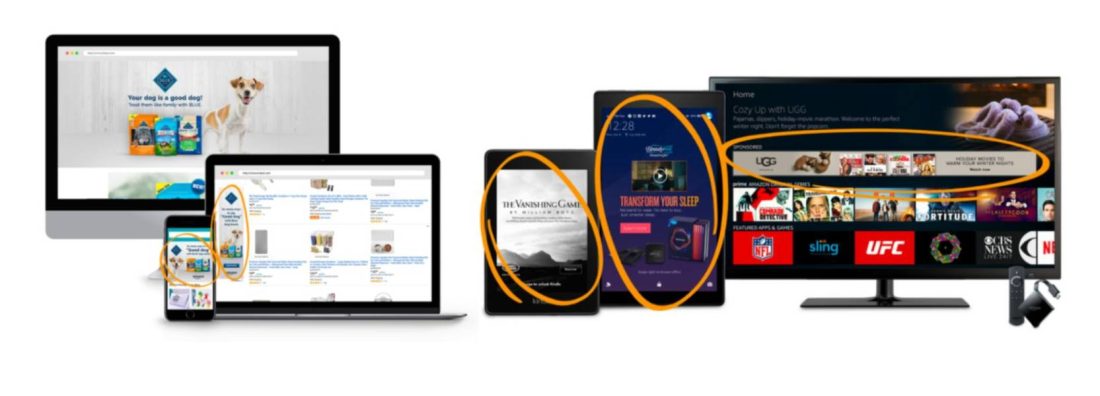
Display ads are the core of most Amazon DSP campaigns because they offer scale across both Amazon and third-party sites. This allows you to stay visible even when users are not actively searching.
They work especially well for retargeting and mid-funnel reinforcement. For example, users who viewed your product can be brought back with reminders or updated messaging, increasing the likelihood of conversion without relying on another search.
You can use dynamic creatives for performance-driven campaigns or static creatives for more controlled branding. This flexibility makes display ads reliable across multiple stages of the funnel.
Video Ads (OLV and OTT/CTV)
Video ads are a high-impact format within Amazon DSP, designed to build awareness and capture attention at scale across both Amazon-owned properties and the open web.
They include both Online Video (OLV) and Over-The-Top (OTT)/Connected TV (CTV) inventory. OLV appears across web and mobile environments such as IMDb and publisher sites, while OTT/CTV delivers ads through streaming platforms like Fire TV and other connected devices.
They work best at the top of the funnel, where visual storytelling helps introduce your product and build recall. For example, users exposed to video ads can later be retargeted with display or REC creatives, reinforcing the message and increasing conversion likelihood.
Because video typically comes at a higher cost, performance depends heavily on audience quality and sequencing. When paired with strong targeting and follow-up campaigns, video ads can significantly improve downstream results.
Audio Ads (Including Podcasts)
Audio ads allow you to reach users during moments when visual formats are not present, such as while streaming music or listening to podcasts.
They are best used for awareness and recall, especially when targeting lifestyle or interest-based audiences.
Like video, audio works best when it is part of a broader sequence. Exposure through audio can be reinforced later through display or video retargeting.
Responsive eCommerce Creatives (RECs)
RECs are dynamic, retail-aware creatives that automatically adapt based on product details, pricing, and availability.
They are most effective for lower-funnel targeting, especially retargeting users who have already interacted with your product or category.
Because they pull in real-time signals, RECs help maintain relevance without requiring constant manual updates.
Static Ads
Static ads give you full control over creative and messaging, which makes them useful for brand storytelling and consistent positioning.
They are often used alongside dynamic formats to balance performance with brand control.
From a targeting perspective, static ads are most effective when paired with well-defined audience segments, where the message can be tailored to a specific intent level.
Lifestyle Targeting: Lower ROAS but Higher CLV
Lifestyle targeting reaches people who habitually buy from a particular category as a consistent pattern, not a one-time purchase.
Amazon infers this from purchase history. A person who regularly buys premium skincare is a lifestyle target for a luxury soap brand.
The ROAS on these campaigns typically looks underwhelming in the first 30 days. The real metric is customer lifetime value.
These audiences may not buy immediately, but when they do, they tend to stay. Do not judge lifestyle targeting based on short-term numbers.
Amazon DSP Interest Targeting: IMDb and Browsing Signals
Amazon DSP interest targeting uses signals from IMDb browsing, category affinity, and content consumption to identify people interested in specific topics.
Someone spending time on IMDb pages for Marvel movies is a valid interest target for a Marvel-themed product.
This format works best for brand affinity plays where you want to reach a culturally relevant audience rather than a purchase-ready one. Do not expect immediate conversions. Expect brand recall that pays off downstream.
Life Event Targeting: High-Intent Moments
Life event targeting identifies people going through transitions that make them unusually likely to buy in new categories.
New parents, recent movers, newly married couples. Amazon identifies these moments from shifts in purchase patterns. A brand selling baby monitors targeting new parents is the textbook use case. Timing is everything here.
Hit the audience too early or too late, and the relevance disappears entirely. When the timing is right,t this targeting type can outperform every broader audience you are running.
Amazon DSP Demographic Targeting: Why Shared Accounts Can Skew Your Data
Amazon DSP demographic targeting lets you filter by age, gender, income, and location. Straightforward in theory,ry but worth using with caution. Amazon builds demographic profiles from account data, and when multiple people share one Amazon account, the data gets messy.
A household account used by a 45-year-old and a 17-year-old creates a blended profile that fits neither. Use demographic targeting as a filter layered on top of behavioral or in-market signals rather than as a standalone targeting type.
In-Market Targeting: Shoppers Close to Purchase
In the market, audiences are people whose recent behavior signals they are actively shopping for a product category right now.
Not just interested, actually in buying mode. Amazon identifies this from browsing frequency, search patterns, and cart behavior.
This is your most conversion-ready audience outside of remarketing. A pet food brand targeting the market of dog food buyers is reaching people who will buy dog food this week. The question is just whether it will be yours.
Contextual Targeting: Reaching New Browsers
Contextual targeting places your ads on pages topically relevant to your product, regardless of who is reading them.
An ad for running shoes on a marathon training blog. An ad for dog food on a pet care article.
You are targeting the content, not the person. Works best for products with short sales cycles where impulse drives the purchase decision.
Device Targeting: Creative Strategy by Device
Device targeting lets you reach specific operating systems, device types, and manufacturers, including Amazon Fire tablets.
The strategic value is creative. When you know your ad is only showing to desktop users, you can build a creative optimized for a large screen without worrying about mobile scaling.
When you are on Fire tablets, you can tailor the experience to that format specifically. Most advertisers run generic creatives everywhere and leave this advantage completely untouched. That is a missed opportunity that costs nothing to fix.
Amazon DSP Retargeting Explained (5 Core Subtypes)
Amazon DSP retargeting focuses on users who have already shown direct intent, making it the most conversion-driven targeting layer.
1. Pixel-Based Remarketing
Targets users who visited your website but did not convert.
Best used when driving external traffic or running DTC funnels where you control pixel data.
It helps re-engage high-intent users who dropped off before purchase.
2. View Remarketing
Targets shoppers who viewed your product on Amazon but did not purchase.
This is a core mid-to-bottom funnel layer used to recover lost conversions.
It works best when paired with strong creatives and short recency windows.
3. Purchased ASIN Remarketing
Targets existing customers who have already purchased your product.
Used for repeat purchases, cross-selling, and increasing customer lifetime value.
This is typically the highest efficiency audience in DSP.
4. Brand Halo Remarketing
Targets users who interacted with other products in your catalog.
Best used to expand basket size and move users across your product ecosystem.
It is especially effective for brands with multiple complementary SKUs.
5. Similar Product Remarketing (Conquesting)
Targets users browsing competitor product listings.
Used to intercept demand at the decision stage and shift consideration toward your product.
Performance depends heavily on pricing, reviews, and offer strength.
The Amazon DSP Attribution Problem (And Why ROAS Lies)
Attribution in Amazon DSP is not always a clean reflection of reality. It tends to prioritize the last interaction instead of the full customer journey, which can distort how performance is reported.
This often leads to inflated metrics, making campaigns look more effective than they actually are. If you rely on these numbers blindly, you risk over-investing in strategies that are not truly driving incremental growth.
Building Amazon DSP targeting strategies that actually hold up means understanding where attribution breaks and how to read performance beyond surface-level metrics.
Last-Touch Attribution Bias
Amazon DSP primarily uses last-touch attribution, which means the final ad interaction before conversion gets full credit.
The issue is that many conversions are influenced earlier by Sponsored Ads, organic search, or even external channels. DSP simply shows up at the end and takes credit.
For example, a user may click a Sponsored Product ad, browse your listing, leave, then later see a DSP retargeting ad and purchase. DSP gets 100 percent of the credit, even though it did not create the original demand.
This makes DSP look more efficient than it actually is and can skew budget decisions.
7-Day vs 14-Day Attribution Window Gap
Another layer of confusion comes from attribution windows.
Sponsored Ads typically use a 7-day window for sellers, while Amazon DSP often uses a 14-day window. This means DSP has a longer time frame to claim conversions.
The result is overlap. The same conversion may fall within both windows, but DSP is more likely to capture it due to the extended timeframe.
This makes direct performance comparisons between channels misleading and can overstate the impact of Amazon DSP campaign targeting.
How Double Counting Inflates Performance
Double-counting happens when multiple campaigns or channels take credit for the same conversion.
In a typical scenario, a user interacts with multiple touchpoints across DSP and Sponsored Ads before purchasing. Each system may report that conversion independently.
When you look at reports in isolation, everything looks profitable. But when you combine them, the numbers don’t add up.
This is why relying only on platform-reported ROAS can be dangerous. To get a clearer picture, you need to look at blended performance or use tools like AMC to reconstruct the actual conversion path.
How to Fix Amazon DSP Attribution Issues
Understanding attribution problems is not enough. You need a system to correct for them when making budget decisions.
1. Use blended performance, not DSP ROAS
Measure total revenue and ROAS across DSP + Sponsored Ads. DSP often drives demand that converts elsewhere.
2. Use AMC for path analysis
Identify assist roles, time lag, and first-touch vs last-touch impact. Optimize for contribution, not just credit.
3. Normalize attribution windows
Compare DSP and Sponsored Ads over the same time frame to reduce reporting bias.
4. Reduce overlap with suppression
Exclude recent buyers and overexposed users. Limit retargeting loops that inflate conversions.
5. Focus on incrementality
Question why this conversion happen without DSP? Use tests, new-to-brand, and trend shifts to validate.
Key Metrics That Actually Matter in Amazon DSP
Each funnel stage needs to be evaluated differently. Judging every campaign by ROAS alone leads to poor decisions, especially at the top of the funnel.
Top funnel measures reach and efficiency, mid funnel measures engagement and intent through signals like Amazon DSP demographic targeting and in-market behavior, and bottom funnel measures conversions and revenue.
Each stage should be evaluated based on its role, not a single metric.
For some Amazon DSP targeting strategies, especially broader audience or lifestyle campaigns, long-term value matters more than immediate ROAS. Looking at customer lifetime value and new-to-brand metrics gives a more accurate picture of performance.
Advanced Amazon DSP Targeting Strategies That Actually Move ROI
Advanced strategies are what separate average campaigns from profitable ones. They focus on efficiency, sequencing, and reducing wasted spend instead of just increasing reach.
At this stage, you’re not asking “which audience should I use?” You’re asking, “How do I control exposure, timing, and overlap across audiences?”
For example, instead of running all Amazon DSP targeting options together, you might:
- Start with Amazon DSP behavioral targeting or interest audiences to build awareness
- move engaged users into in-market segments
- Then push only high-intent users into Amazon DSP retargeting
Another example is budget control through exclusion. Rather than targeting everyone who viewed your product, you exclude:
- users who already purchased in the last 30 days
- users who have seen your ad multiple times but did not engage
This reduces wasted impressions and improves overall efficiency.
You can also combine channels strategically. A common approach is:
- Run DSP to drive awareness and traffic
- Let Sponsored Ads capture that demand when users search later
Using AMC for Suppression, Not Just Reporting
- Exclude users who have already converted
- Build suppression lists by recency, frequency, or purchase behavior
- Reduce wasted impressions on low-value audiences
- Use AMC to identify overlap between DSP and Sponsored Ads
- Focus spending on users who are still in the decision phase
Pre-Event Audience Warming (4 to 6 Weeks Before Peak Events)
- Start building audience pools before Prime Day or seasonal spikes
- Use behavioral and interest targeting early
- Shift to retargeting closer to the event
- Avoid launching DSP during peak periods without warm audiences
- Lower CPMs early, higher conversion rates later
Combining DSP with Sponsored Ads for Demand Capture
- DSP drives awareness and consideration
- Sponsored Ads capture high-intent searches
- Expect a lift in branded search volume from DSP
- Measure blended performance, not channel-level ROAS
- Align messaging across both channels
When Sponsored Ads Will Outperform Amazon DSP Campaign Targeting
If your fundamentals are not strong, adding DSP will only amplify inefficiencies instead of fixing them.
If your budget is limited, your listings are under-optimized, or your conversion rates are inconsistent, Sponsored Ads are more effective. They capture existing demand and give you clearer, more immediate feedback on what is working.
DSP works best when you are ready to scale. Once your listings convert well and your Sponsored Ads are stable, DSP can expand reach, build demand, and drive incremental growth beyond search.
Final Takeaway: When Amazon DSP Targeting Actually Makes Sense
Amazon DSP targeting works best when treated as a system rather than a one-off tactic.
It requires clear audience selection, structured Amazon DSP targeting strategies, and performance measurement that looks beyond surface-level ROAS.
This means understanding which campaigns drive awareness, which drive consideration, and which actually convert.
When executed properly, it becomes a predictable growth channel that not only captures demand but actively creates it, leading to more stable and scalable performance over time.
If you are evaluating DSP partners, SellerApp is worth a conversation. We combine AI, AMC data, and a full-funnel strategy to help you grow with advanced programmatic advertising.
1. What is the minimum budget to start Amazon DSP
Understanding your Amazon DSP targeting options before committing budget is critical. The self-service option typically requires $12,000 to $15,000 per month and demands strong Amazon DSP campaign targeting expertise to avoid wasting spend.
Amazon’s managed service requires a minimum of $50,000, which covers dedicated management and premium inventory. For brands evaluating Amazon DSP targeting capabilities, working through a certified agency like SellerApp gives you access at more flexible thresholds with professional campaign management included.
2. Can brands that do not sell on Amazon use Amazon DSP targeting?
Yes. DSP is available to any advertiser, regardless of whether they sell on Amazon. Amazon DSP targeting strategies go far beyond the marketplace itself, letting non-Amazon brands leverage first-party shopper data to reach audiences based on real purchase and browsing behavior.
The Amazon DSP targeting features available to non-sellers include the full audience stack, pixel-based conversion tracking, and CRM data uploads, making it genuinely powerful for DTC brands looking to scale.
3. How are Amazon DSP targeting features different from Sponsored Display?
Amazon DSP targeting features go much deeper than Sponsored Display. While Sponsored Display is self-serve with a limited audience stack, Amazon DSP targeting options cover behavioral, lifestyle, in-market, contextual, lookalike, and CRM based audiences.
Amazon DSP targeting capabilities also extend to inventory across the open web, third-party publishers, and Amazon-owned properties like IMDb and Fire TV. Sponsored Display simply cannot reach those placements, which is what makes DSP the stronger full funnel tool.
4. What is the attribution window for Amazon DSP retargeting
Amazon DSP retargeting uses a 14-day click and 14-day view attribution window. This is where most Amazon DSP campaign targeting reports start to mislead.
The window overlaps with Sponsored Ads attribution, especially for vendors, which means the same conversion gets claimed by both channels simultaneously. Without deduplication, your
Amazon DSP targeting strategies will always look more efficient than they actually are. Running AMC queries reconstructs the real conversion path and gives you an honest performance read across all your Amazon DSP retargeting campaigns.
5. Is Amazon DSP interest targeting worth it for small brands
Amazon DSP interest targeting is an awareness play that requires budget and patience. For small brands, the better starting point is Amazon DSP behavioral targeting, which reaches shoppers based on recent actions and sits much closer to purchase intent, or
Amazon DSP demographic targeting layered on top of in-market signals for a more precise mid-funnel approach. Amazon DSP retargeting is also a stronger short-term bet than interest targeting for brands with limited spend.
Once you have a solid retargeting pool and proven conversion rate, Amazon DSP interest targeting becomes worth scaling into new audiences.
The post Amazon DSP Targeting Tactics to Recover Lost Conversions and Scale What Works appeared first on SellerApp Blog.
from SellerApp Blog https://ift.tt/U2D6WGZ
via IFTTT
Add a review