
Sellerboard Alternatives for Amazon Sellers Who’ve Outgrown Profit Reports
Descriptions
The best Sellerboard alternative for growing Amazon brands is the platform that connects profitability with advertising, inventory, and performance data. Sellerboard remains a strong choice for profit tracking, but brands managing larger catalogs, higher ad spend, or more complex operations often need deeper visibility into what’s driving growth. Tools like SellerApp, Helium 10, and Perpetua extend beyond profitability reporting to provide broader operational insights.
That works well in the early stages. But as ad spend increases, product catalogs expand, and competition becomes more aggressive, understanding whether profit increased or decreased is no longer enough. Sellers need to understand why it happened and which factors are influencing profitability.
In this guide, we’ll look at where Sellerboard works well, where its limitations start to appear, and the best Sellerboard alternatives for Amazon US sellers in 2026.
Quick Gudie:
- What Sellerboard Doesn’t Cover And When It Becomes a Problem for US Sellers
- Who Should Use Sellerboard And When To Consider Sellerboard Alternatives
- What to Look for in a Sellerboard Alternative
- Best Sellerboard Alternatives for Amazon US Sellers
- Why Amazon DSP Changes the Sellerboard Conversation
- When Ad Spend Outgrows Profit Tracking
- How SellerApp Connects Ad Performance to Actual Profit
- Inventory and Listing Intelligence Without Switching Tools
- Final Verdict: Which Sellerboard Alternative Should US Amazon Sellers Choose in 2026?
- FAQ
What Sellerboard Doesn’t Cover And When It Becomes a Problem for US Sellers
Most sellers looking for a Sellerboard alternative are not actively trying to replace Sellerboard. In fact, it remains one of the most widely used profit tracking tools among Amazon sellers because it solves an important problem well: understanding profitability.
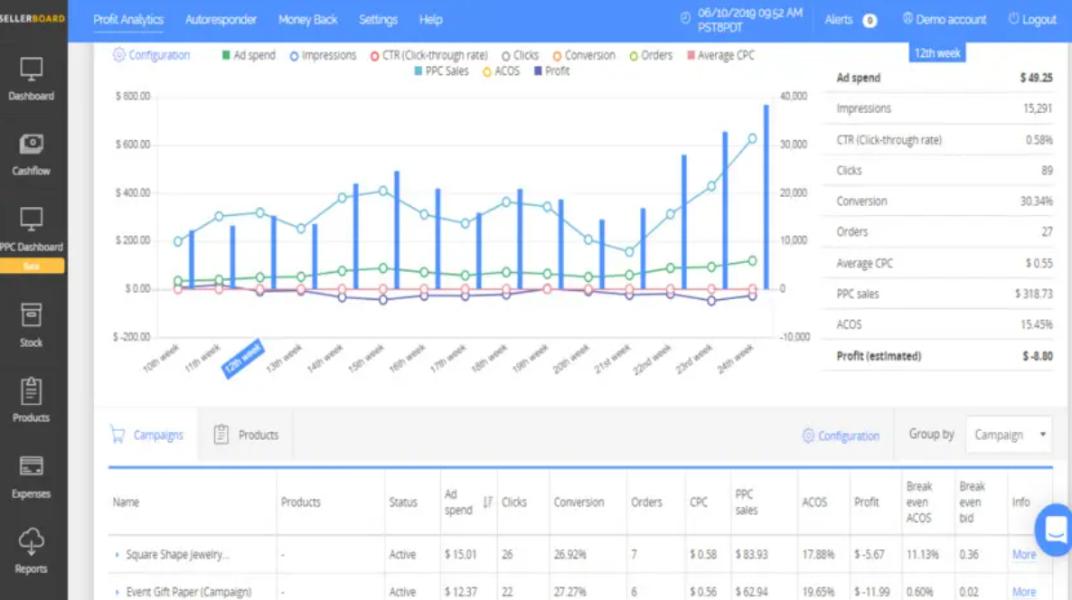
Sellerboard gives sellers visibility into revenue, profit, Amazon fees, refunds, advertising costs, and operational expenses through a straightforward dashboard. For smaller brands managing a limited catalog and modest advertising budgets, this level of reporting is often enough to understand whether the business is moving in the right direction.
[Add Sellerboard Profit Dashboard Screenshot Here]
Image Title: Sellerboard Profitability Dashboard and Expense Tracking Features
The challenge appears when profitability is no longer influenced by a handful of variables. As brands grow, advertising spend increases, Amazon catalogs expand, and competition becomes more aggressive. A decline in profit could be caused by rising CPCs, lower conversion rates, inventory constraints, organic ranking losses, or increased competition on high-intent keywords.
Sellerboard can help identify the outcome. However, improving that outcome often requires visibility beyond profitability reporting alone. Sellers need to understand which campaigns are driving growth, which keywords are becoming more expensive, whether inventory issues are affecting performance, and how competitors are influencing market share.
This is where many Sellerboard competitors begin to differentiate themselves. Rather than focusing primarily on profit tracking, they combine advertising intelligence, inventory visibility, competitive insights, and operational analytics to help sellers understand what is actually driving profitability and long-term growth.
Where Sellerboard Works Well
Before comparing Sellerboard competitors, it’s worth acknowledging where Sellerboard delivers the most value. The platform is designed for sellers who want straightforward profitability reporting without the complexity of a larger Amazon software stack.
| Sellerboard Strength | Why It Matters |
| Profit Tracking | Provides visibility into revenue, profit, |
| fees, refunds, and advertising costs from a single dashboard. | |
| Expense Monitoring | Helps sellers account for operational expenses beyond Amazon fees. |
| Advertising Cost Visibility | Connects ad spend to profitability, making it easier to understand margin impact. |
| Refund & Fee Tracking | Highlights deductions that affect overall profitability. |
| Simple Reporting | Easy to understand without requiring extensive training or setup. |
The Gap That Appears When You Start Scaling Ad Spend
The search for a Sellerboard alternative often begins when advertising becomes a major growth channel.
A brand spending $5,000 per month on Amazon Ads can often review campaigns manually and make decisions based on profitability reports. A brand spending $100,000 per month across dozens of campaigns, hundreds of keywords, and multiple products faces a different challenge entirely.
Sellerboard provides useful visibility into profitability by helping sellers track revenue, fees, refunds, advertising costs, and margins. For smaller operations, these insights are often enough to understand whether the business is performing well.
As advertising budgets and product catalogs grow, however, profitability becomes the result of multiple interconnected factors. Rising CPCs, declining organic visibility, inventory constraints, changing Amazon conversion rates, and increased competition can all impact performance long before they become visible in a profit report.
At that stage, understanding profit is only part of the equation. Brands also need visibility into campaign performance, keyword trends, inventory health, competitive activity, and customer acquisition costs to understand what is driving growth and profitability.
This is where many Sellerboard alternatives begin to differentiate themselves. While Sellerboard helps measure financial outcomes, growing brands often need additional intelligence across advertising, Amazon inventory, and market performance to identify opportunities, reduce inefficiencies, and scale profitably.

Who Should Use Sellerboard And When To Consider Sellerboard Alternatives
Not every Amazon seller needs a Sellerboard alternative.
Sellerboard remains a strong option for sellers who want a cost-effective way to manage profitability while also gaining access to features such as Amazon PPC optimization, inventory monitoring, reimbursement tracking, and seller alerts. For many small and mid-sized Amazon businesses, this combination provides enough visibility to manage day-to-day operations effectively.
Sellerboard is particularly well-suited to sellers managing a smaller catalog, running modest advertising budgets, or using separate tools for advertising, product research, and inventory planning. In these situations, its profitability-focused approach often delivers the insights needed without adding unnecessary complexity.
At that point, the question is no longer whether the business is profitable. The question is what is driving that profitability and how it can be improved.
What to Look for in a Sellerboard Alternative
Most sellers searching for a Sellerboard alternative assume they need another profit tracking tool.
In reality, profit is usually the symptom, not the problem.
If margins are shrinking, the cause could be rising advertising costs, declining organic visibility, inventory constraints, increased competition, or even poor product selection. That is why many sellers eventually move beyond simple profitability reporting and look for tools that help them understand what drives business performance.
Before comparing Sellerboard competitors, it helps to identify the capabilities that matter most to your business. Some tools specialize in product research. Others focus on Amazon PPC automation, customer retention, Amazon inventory management, or profitability analytics. A few attempt to connect multiple drivers of growth within a single platform.
The table below breaks down the key capabilities worth evaluating when choosing a Sellerboard alternative and highlights the tools most commonly associated with each area.
| Capability | What It Helps You Understand | Why It Matters | Tools Often Considered |
| Profit Tracking Beyond Revenue and Fees | True profitability after fees, ad spend, refunds, and operational costs | Helps sellers understand whether revenue growth is | Sellerboard, Shopkeeper, SellerApp |
| translating into actual profit growth | |||
| PPC Intelligence | Which campaigns, keywords, and products are driving profitable growth | Advertising is often the largest controllable expense in an Amazon business | Perpetua, SellerApp |
| Inventory Visibility | Replenishment risks and inventory health | Stockouts can hurt rankings, conversions, and future revenue long before they appear in profit reports | Helium 10, SellerApp |
| Product Research | Market demand, competition, and product opportunities | The wrong product can limit profitability before a campaign is ever launched | Jungle Scout, Helium 10 |
| Customer Retention | Repeat purchases and customer lifetime value | Acquiring a customer is expensive. Retaining one is often more profitable | ManageByStats |
| Competitive Intelligence | Pricing changes, keyword competition, and market trends | Profitability is influenced by market conditions, not just internal performance | Helium 10, SellerApp |
| Full-Funnel Visibility | How advertising, inventory, visibility, and profitability influence each other | Helps sellers understand what is driving business performance instead of analyzing metrics in isolation | SellerApp, Helium 10 |
Best Sellerboard Alternatives for Amazon US Sellers
Most sellers searching for a Sellerboard alternative are not actually looking for another way to track profit. They’re trying to understand what is affecting profit.
A drop in margins rarely happens because of a single factor. It could be rising advertising costs, declining conversion rates, inventory issues, increased competition, or poor product selection. Profit is simply the result of everything happening across the business.
That is why different Sellerboard competitors appeal to different types of Amazon sellers. Some focus on helping sellers find better products. Others specialize in advertising automation, customer retention, inventory visibility, or profitability analytics.
The best Sellerboard alternative depends on which part of the profitability equation you need help improving. Here are the best of the best:
SellerApp: For Brands Building a Full-Funnel Amazon Growth Engine
For Amazon brands that need visibility beyond profitability reporting, SellerApp is one of the most comprehensive Sellerboard alternatives available.
While Sellerboard excels at helping sellers understand profitability, SellerApp is designed to help brands understand the factors influencing that profitability. The platform combines PPC intelligence, Amazon DSP, Amazon Marketing Cloud (AMC), inventory forecasting, keyword intelligence, listing quality analysis, category share reporting, competitive insights, and profitability analytics within a single ecosystem.
This approach is particularly valuable for larger brands, aggregators, and agencies managing increasingly complex operations. Rather than switching between multiple tools to understand advertising performance, inventory health, market share, and profitability, teams can evaluate these metrics within a broader business context.
As businesses scale, profitability becomes the result of multiple interconnected factors. A product may appear less profitable because CPCs are rising. Another may be losing organic visibility. Inventory constraints may be limiting growth opportunities, while competitors gain share on high-intent keywords. Looking at these signals in isolation often creates blind spots. Looking at them together creates context.
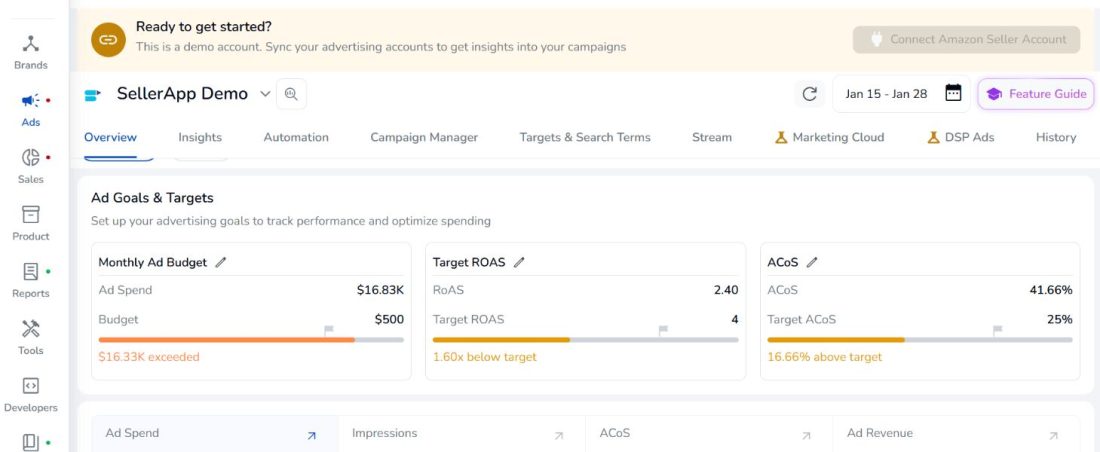
SellerApp’s full-funnel approach extends beyond Sponsored Ads. By combining Amazon DSP, AMC analytics, Sponsored Ads performance, and profitability data, brands gain a clearer understanding of how customers move from awareness and consideration to conversion and long-term growth.
For brands asking not just “What is my profit?” but “What is driving my profit?”, SellerApp offers a broader set of capabilities than traditional profitability-focused platforms.
Strengths:
- Profitability analytics connected to advertising performance
- Amazon DSP and AMC integration
- PPC intelligence and automation
- Inventory forecasting and operational visibility
- Keyword intelligence and listing quality analysis
- Category share and competitive insights
- Built for brands, agencies, and aggregators managing growth at scale
Limitations:
- More functionality than smaller sellers may require
- Greater learning curve than basic profit-tracking tools
- May be more platform than early-stage sellers need
Shopkeeper: For Sellers Who Want Another Profit-First Tool
For sellers whose main frustration with Sellerboard is the interface rather than the feature set, Shopkeeper is worth evaluating as a Sellerboard alternative.
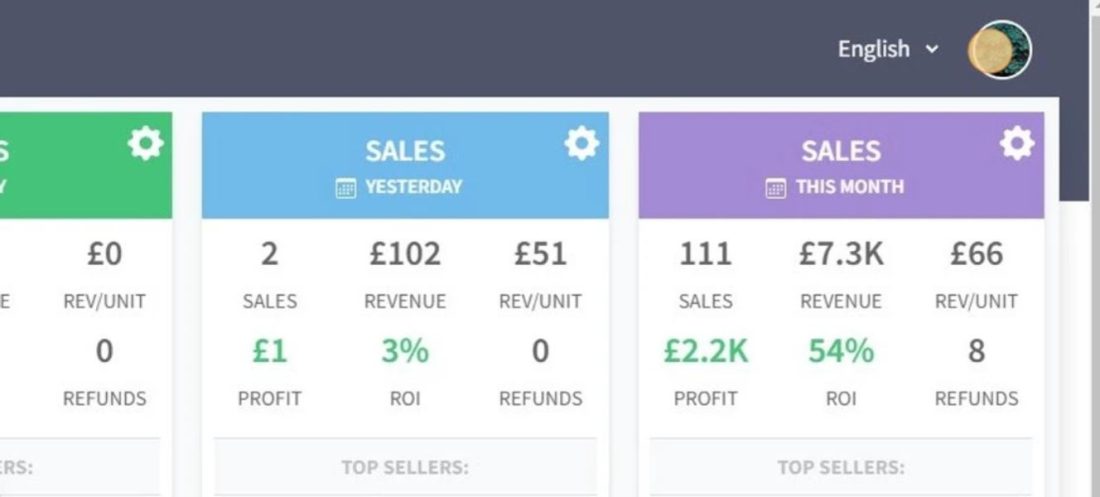
It matches Sellerboard closely on profit tracking revenue, fees, refunds, and margins in a clean dashboard, but adds a more visual, per-product profit breakdown that some sellers find easier to act on. Pricing is comparable, and the learning curve is minimal.
Best for: Sellers who want a profit-tracking experience similar to Sellerboard.
Strengths:
- Clear profitability reporting
- Easy-to-understand financial dashboards
- Accurate fee and expense tracking
- Simple implementation and setup
- Useful for monitoring business health
Limitations:
- Limited PPC optimization features
- No advanced competitive intelligence tools
- Minimal inventory forecasting capabilities
- Focused more on reporting outcomes than identifying growth opportunities
The honest limitation is the same one Sellerboard has: it tells you what your profit is, not what’s driving it. For a small catalog with stable ad spend, that’s often enough.
Jungle Scout: For Sellers Who Believe Profit Starts With Product Selection
When comparing Sellerboard vs Jungle Scout, you’re really comparing two different phases of the Amazon business. Jungle Scout is built for decisions made before launch, validating demand, sizing markets, and identifying gaps in a category. It does this better than almost any other tool.
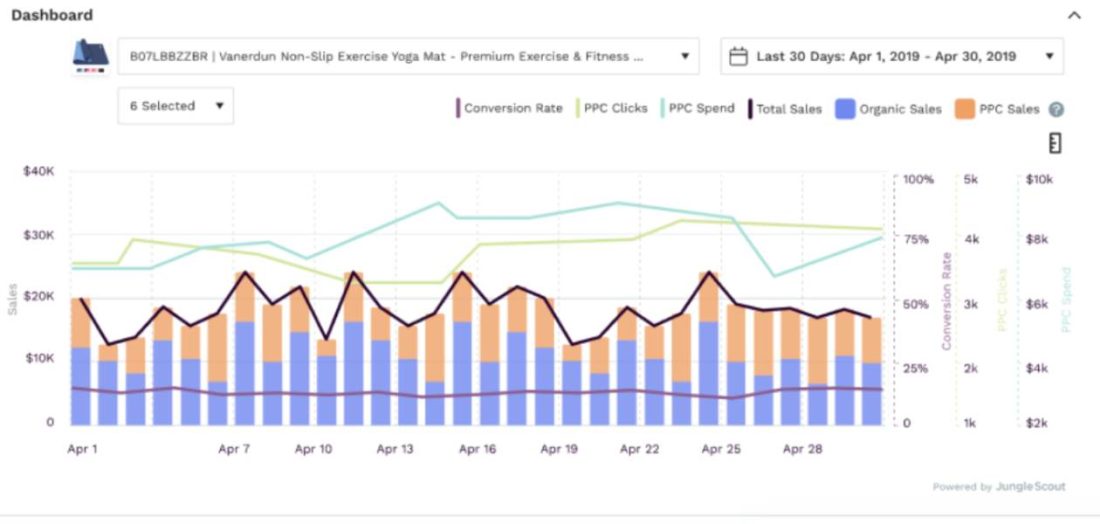
Where it falls short as a sellerboard alternative is post-launch: there’s no meaningful profit tracking, no PPC intelligence, and limited inventory visibility. Sellers who are still building their catalog will find Jungle Scout genuinely useful.
Sellers already running at scale will likely need it alongside something else, not instead of something else.
Best for: Product research, market validation, and catalog expansion
Strengths:
- Market and product opportunity research
- Keyword research and rank tracking
- Supplier database and sourcing support
- User-friendly interface for new and growing sellers
- Strong product launch support
Limitations:
- Primarily focused on product research rather than operational intelligence
- Limited advertising optimization capabilities
- Basic profitability analysis compared to specialized tools
- Less suited for brands managing complex advertising operations
ManageByStats: Best for Customer Retention and Lifetime Value Tracking
ManageByStats occupies a niche that many Sellerboard alternatives largely overlook: what happens after the first sale. The platform combines profitability reporting with customer analytics, repeat purchase tracking, email follow-up automation, and lifetime value measurement.
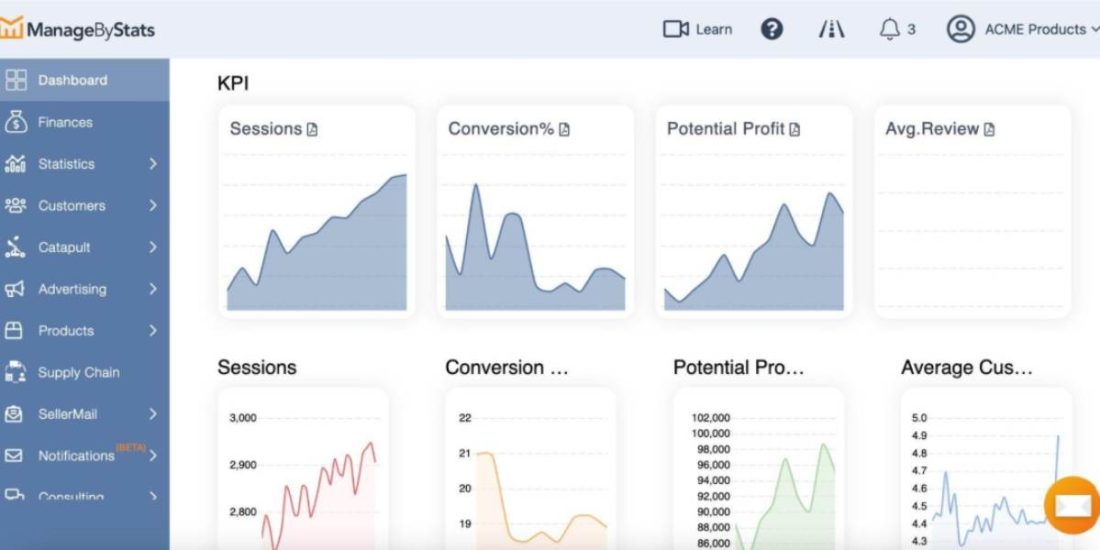
This makes it particularly useful for brands selling consumables, supplements, beauty products, or other products with strong repurchase potential. In these categories, increasing customer lifetime value can often have a greater impact on profitability than improving advertising efficiency alone.
Best for: Brands focused on repeat purchases, customer retention, and lifetime value optimization.
Strengths:
- Customer lifetime value tracking
- Repeat purchase analytics
- Email follow-up automation
- Customer segmentation and retention insights
Limitations:
- Limited PPC intelligence
- No advanced DSP or AMC capabilities
- Less visibility into inventory forecasting and competitive intelligence
- Not designed for Amazon full-funnel advertising analysis
For sellers primarily focused on improving retention and customer value, ManageByStats offers capabilities that many Sellerboard competitors do not. However, brands looking to connect advertising performance, inventory health, profitability, and customer acquisition within a single platform may find broader solutions, such as SellerApp, better suited to long-term growth initiatives.
Perpetua: Best for PPC Automation at Scale
Among Sellerboard competitors focused on advertising, Perpetua is one of the most established platforms for PPC automation. Its core strength lies in helping brands automate bidding, optimize campaigns, and improve advertising efficiency without requiring constant manual intervention.
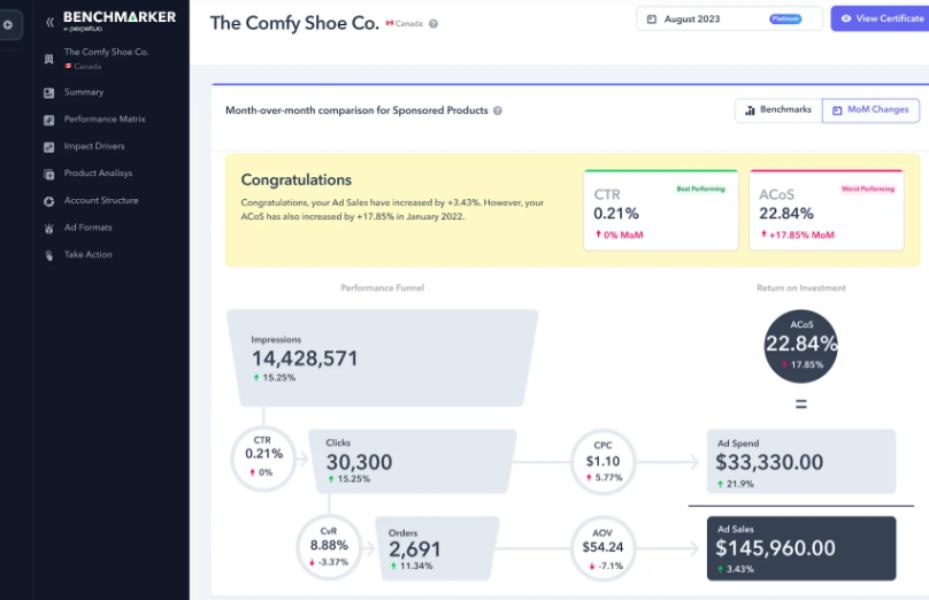
For brands spending tens of thousands of dollars per month on Sponsored Ads, this can translate into meaningful time savings and performance improvements. Campaign management becomes increasingly complex as keyword counts grow, product catalogs expand, and advertising budgets scale. Perpetua is designed to reduce that operational burden through automation.
Best for: Brands prioritizing PPC automation and campaign efficiency.
Strengths:
- Automated bid optimization
- Campaign management at scale
- Advertising performance monitoring
- Reduced manual PPC workload
Limitations:
- Limited visibility into inventory health and forecasting
- No native competitive intelligence capabilities
- Less focus on profitability analytics beyond advertising metrics
- Limited DSP and AMC integration compared to broader growth platforms
The primary tradeoff is visibility. Perpetua helps brands improve advertising performance, but advertising is only one part of the profitability equation. A stronger ROAS does not always translate into stronger margins once fees, inventory constraints, and operational costs are considered.
For sellers whose primary bottleneck is Amazon PPC management, Perpetua can be a strong alternative to Sellerboard. For brands looking to connect advertising performance with inventory, profitability, competitive insights, and full-funnel growth strategies, broader platforms such as SellerApp may provide a more complete view of business performance.
Helium 10: For Operators Managing Multiple Moving Parts
In most sellerboard vs Helium 10 conversations, the real question is whether you want one platform or best-in-class tools stitched together.
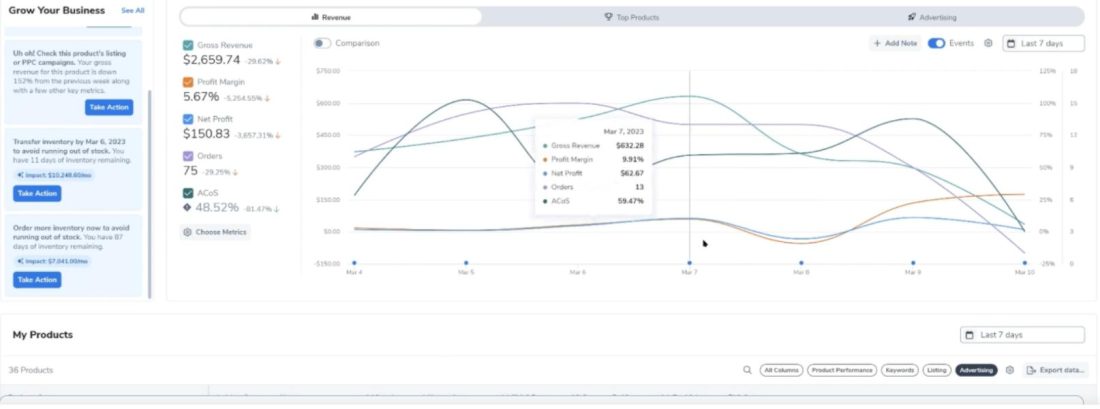
Helium 10 covers an unusually wide range of keyword research, listing optimization, inventory alerts, profit tracking, and market intelligence under one login.
Best for: Sellers who want product research, listings, inventory, and operations in one platform.
Strengths:
- Comprehensive product research tools
- Keyword tracking and listing optimization
- Inventory management capabilities
- Large suite of seller tools in one platform
- Strong support for product discovery and launch strategies
Limitations:
- Can feel overwhelming due to the number of tools available
- Profitability insights are not as central as dedicated profit-tracking platforms
- Limited DSP and AMC capabilities
- Less focused on connecting advertising, inventory, and profitability within a single workflow
The tradeoff is depth: each tool is solid but rarely class-leading in its specific category. For operators who find tool-switching genuinely painful and want one ecosystem that covers 80% of their needs reasonably well, Helium 10 is one of the strongest Sellerboard alternatives available. For sellers who need deep PPC analytics or serious DSP capability, it may still leave gaps.
Sellerise: For Sellers Balancing Capability and Cost
Sellerise sits in an interesting position among sellerboard alternatives: it bundles more features than Sellerboard at a price point designed for sellers who aren’t ready to pay for a premium suite.
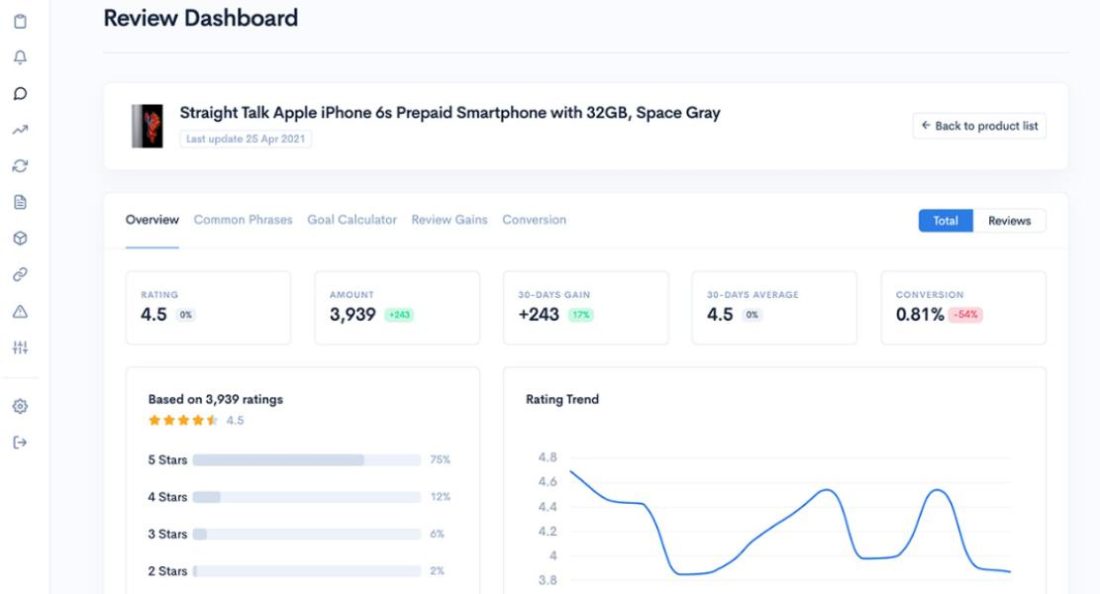
You get profitability tracking, keyword alerts, reimbursement monitoring, and listing tools in one subscription. None of these match the depth of a dedicated tool in each category, but for a seller managing a mid-sized catalog without a large software budget, the breadth-for-price ratio is genuinely competitive.
It’s worth evaluating if your main frustration with Sellerboard is needing to pay for three additional tools to cover basic operational needs.
Best for: Sellers looking for a broader feature set than Sellerboard without investing in an enterprise platform.
Strengths:
- Affordable pricing
- Profit tracking and operational reporting
- Inventory alerts and reimbursement monitoring
- Customer engagement features
- Broad functionality for small and mid-sized sellers
Limitations:
- Limited advanced advertising intelligence
- Less comprehensive competitive analysis
- Not designed for large-scale advertising operations
- Fewer enterprise-grade reporting capabilities
Why Amazon DSP Changes the Sellerboard Conversation
Most profit tracking tools help sellers understand what happened after a sale. The challenge for growing brands is understanding what influenced the sale in the first place.
As brands scale advertising spend, growth increasingly depends on reaching shoppers before they enter the buying stage. Amazon DSP allows advertisers to build awareness, retarget audiences, and engage potential customers across multiple touchpoints, extending visibility beyond traditional Sponsored Ads.
This creates a new layer of complexity that profit reporting alone cannot explain. A customer may interact with multiple campaigns before converting, making it difficult to understand which touchpoints contributed to revenue.
By combining Amazon DSP, Sponsored Ads, AMC insights, and profitability analytics, SellerApp helps brands connect advertising activity across the funnel rather than evaluating individual campaigns in isolation.
Recent additions such as SellerApp’s DSP dashboard further simplify full-funnel campaign management by giving brands a unified view of DSP and Sponsored Ads performance alongside profitability metrics.
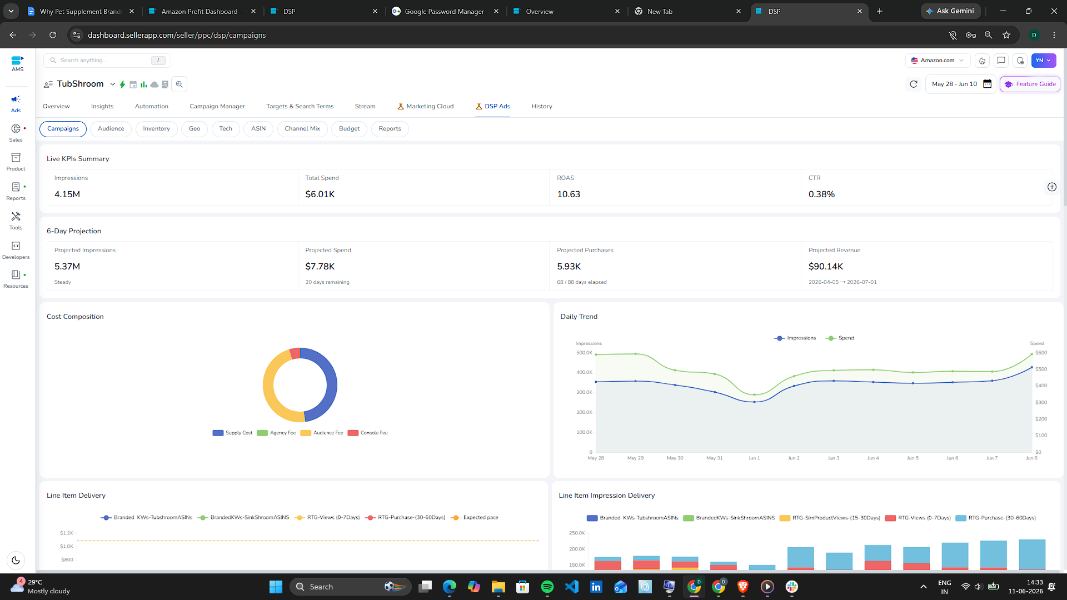
For larger brands and agencies, this creates a more complete view of how advertising investments influence business growth.
When Ad Spend Outgrows Profit Tracking
Sellerboard does a good job of helping sellers understand whether they’re making money.
The challenge is that profitability becomes increasingly difficult to improve as advertising budgets grow.
A seller spending $2,000 per month on Amazon Ads can often identify performance issues manually. A brand spending $50,000, $100,000, or even $500,000 per month faces a different reality. At that scale, profitability is influenced by thousands of keyword decisions, changing competitive dynamics, inventory availability, conversion rates, and customer acquisition costs.
The question is no longer whether profit increased or decreased. The question is why.
How SellerApp Connects Ad Performance to Actual Profit
Most profit tracking tools answer one question: What happened? Growing brands often need answers to a different question: Why did it happen?
This is where platforms that combine advertising intelligence, inventory visibility, and profitability analytics begin to create more value than standalone reporting tools.
Geomag is a good example of this. After restructuring campaigns, implementing search term audits, improving keyword targeting, and optimizing bids through SellerApp, the brand increased total sales from $174K to $215K, reduced CPCs from $1.77 to $1.17, cut wasted ad spend by 98%, and achieved an all-time low 16% TACoS.
Instead of viewing profitability as a standalone metric, Geomag gained visibility into the campaign-level factors influencing growth, allowing the brand to scale sales while improving advertising efficiency.
Inventory and Listing Intelligence Without Switching Tools
Advertising performance rarely exists in isolation. A product with poor inventory health may lose sales despite strong advertising. A listing with weak content may struggle to convert traffic regardless of how much budget is allocated to campaigns.
The challenge is that many sellers monitor these metrics across separate platforms.
Inventory data lives in one dashboard. Advertising data lives in another. Listing performance sits somewhere else. Profitability reporting exists in a fourth system.
As businesses grow, switching between platforms becomes increasingly inefficient.
SellerApp brings inventory forecasting, listing quality analysis, profitability reporting, advertising intelligence, and competitive data together, allowing sellers to evaluate performance within a broader business context.
Instead of reacting to individual metrics, teams can understand how changes in one area affect performance across the entire account.
A recent example is NorthSide, where SellerApp combined multiple capabilities into a unified growth strategy.
Using Amazon DSP, Amazon Marketing Cloud (AMC), AI-powered bid automation, search term audits, and inventory-aware budget allocation, SellerApp helped NorthSide transform advertising efficiency at scale.
The brand achieved a 241% increase in revenue, improved ROAS from 2.58x to 20.3x, and reduced ACoS from 84% to 4.71%, demonstrating how a full-funnel strategy can improve both growth and profitability simultaneously.
NorthSide’s results highlight an important reality for growing brands: profitability is rarely driven by a single metric. It is the combined impact of advertising efficiency, audience targeting, inventory readiness, and visibility that ultimately determines growth.
A product may appear less profitable because CPCs have increased. Another may be losing visibility on high-intent keywords. A third may be constrained by inventory availability. Looking at profitability alongside advertising and operational data helps sellers identify those patterns much faster.
Final Verdict: Which Sellerboard Alternative Should US Amazon Sellers Choose in 2026?
The best Sellerboard alternative depends on what you’re trying to improve. If your primary goal is profit tracking, Sellerboard remains a strong choice. It delivers the visibility most small and mid-sized sellers need to understand revenue, fees, advertising costs, and margins without adding unnecessary complexity.
However, profitability becomes harder to manage as businesses grow. Advertising costs increase. Product catalogs expand. Competition becomes more aggressive. Inventory issues begin affecting performance.
At that point, understanding whether profit increased or decreased is only part of the equation. The bigger challenge is understanding why.
That is where different Sellerboard competitors begin to separate themselves.
Jungle Scout is a strong option for sellers focused on product research and market validation. ManageByStats appeals to brands that prioritize customer retention and lifetime value. Perpetua is designed for sellers looking to automate advertising decisions at scale. Helium 10 remains one of the most comprehensive platforms for sellers managing multiple aspects of their Amazon business.
SellerApp takes a different approach.
Instead of focusing on a single function, it combines profitability analytics, PPC intelligence, Amazon DSP, Amazon Marketing Cloud (AMC), inventory forecasting, listing intelligence, keyword tracking, and competitive insights into a unified growth platform. This allows brands to understand how advertising, inventory, visibility, and profitability influence one another across the customer journey.
If all you need is a profit dashboard, Sellerboard is still a solid choice.
If you’re asking deeper questions about what is driving profitability and how to improve it, SellerApp is one of the strongest Sellerboard alternatives for brands that need visibility beyond profit tracking.
As your Amazon business grows, the question changes from “What happened?” to “Why did it happen?” SellerApp helps answer both. Explore how full-funnel visibility can help you uncover growth opportunities, improve advertising efficiency, and make more profitable decisions. Talk to a SellerApp expert.
FAQ
1. What is the best Sellerboard alternative for Amazon sellers in 2026?
The best Sellerboard alternative depends on your business goals. If you primarily need profit tracking, Sellerboard and Shopkeeper remain strong options. However, brands managing larger catalogs, higher advertising budgets, and more complex operations often look for Sellerboard alternatives that combine profitability analytics with PPC intelligence, inventory visibility, and competitive insights. Platforms like SellerApp are designed to provide that broader visibility across the Amazon business.
2. Which tool is better than Sellerboard for sellers spending heavily on Amazon Ads?
For brands investing heavily in Amazon PPC, the challenge is rarely profit tracking alone. Sellers often need visibility into keyword performance, advertising efficiency, inventory health, and organic rankings alongside profitability data. This is where tools that combine advertising intelligence with profit analytics can be better than Sellerboard for growth-focused brands. SellerApp, for example, connects PPC performance, Amazon DSP, profitability analytics, and inventory forecasting within a single platform.
3. How does Helium 10 compare as a Sellerboard alternative?
The Sellerboard vs Helium 10 comparison comes down to specialization versus breadth. Sellerboard focuses purely on profitability reporting. Helium 10 covers keyword research, listing optimization, inventory alerts, and basic profit tracking under one login. For sellers who want one platform to handle multiple operational needs, Helium 10 is one of the more comprehensive sellerboard alternatives available. For sellers who need deep PPC analytics or DSP capability, both tools have gaps.
4. Which Sellerboard competitors offer both profit tracking and PPC management?
Many Sellerboard competitors focus on a single area such as product research, customer retention, or advertising automation. SellerApp is one of the few solutions that connects advertising performance, keyword tracking, inventory health, and profitability reporting in one ecosystem, making it particularly useful for brands scaling their Amazon advertising efforts.
5. When should an Amazon seller switch from Sellerboard to another platform?
Most sellers start looking for a Sellerboard alternative when profit tracking no longer answers the questions they need answered. If you’re constantly switching between multiple tools to understand why profits changed, why advertising costs increased, or why visibility is declining, it may be time to evaluate Sellerboard alternatives that offer deeper operational insights. Growing brands often find that platforms like SellerApp provide a more complete picture of how advertising, inventory, visibility, and profitability work together to drive business performance.
6. Is SellerApp better than Sellerboard for agencies and aggregators?
For agencies and aggregators managing multiple brands, SellerApp often provides broader visibility than Sellerboard. While Sellerboard focuses on profitability reporting, SellerApp combines PPC intelligence, Amazon DSP, AMC analytics, inventory forecasting, and competitive insights alongside profitability data.
Sellerboard is a strong choice for tracking profit. SellerApp is better suited for teams that need to understand what’s driving profit across advertising, inventory, and market performance.
The post Sellerboard Alternatives for Amazon Sellers Who’ve Outgrown Profit Reports appeared first on SellerApp Blog.
from SellerApp Blog https://ift.tt/YIOCz5J
via IFTTT
Add a review